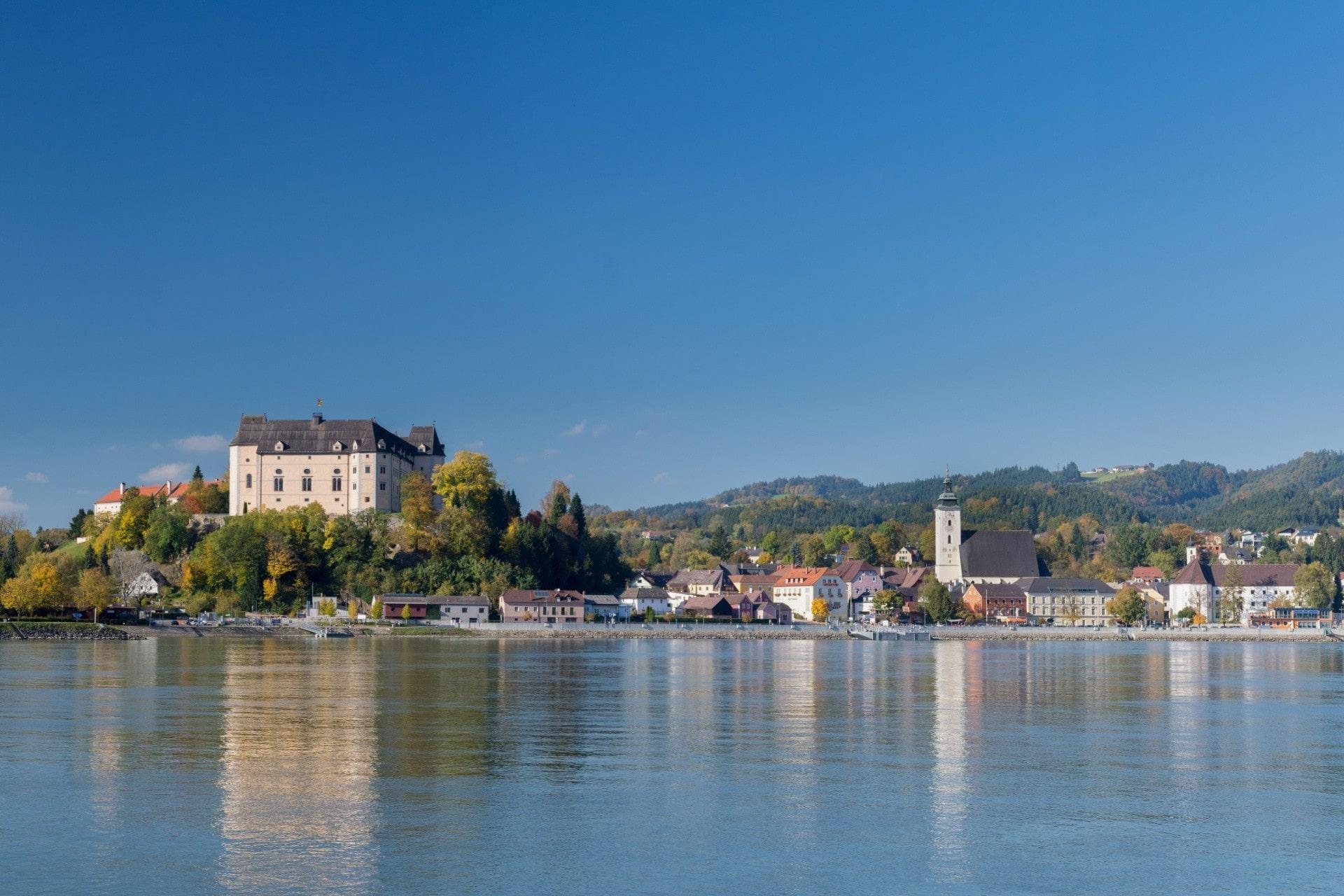
Beyond the Port™: Grein, Austria
The Little Danube Town That the River Made Important
On a Danube river cruise, it is easy to understand why Vienna gets your attention. Budapest practically demands it. Even smaller destinations such as Dürnstein announce themselves with vineyards, castle ruins and postcard views.
Then there is Grein.
Sitting quietly along the Danube in Upper Austria, Grein doesn't immediately look like a place that once mattered to nearly everyone attempting to navigate this stretch of the river.
But that's precisely what makes it interesting.
Behind the colorful buildings and peaceful waterfront is a town shaped by dangerous water, river pilots, centuries of shipping, an imposing castle and one of the most unusual little theaters you'll find anywhere in Austria.
Grein is one of those places that explains why I enjoy looking Beyond the Port.
Before the Danube Was Scenic, It Could Be Dangerous
Today, we tend to think of a Danube cruise as peaceful: vineyards, villages and castles passing outside the window.
The river that earlier generations knew could be very different.
Grein sits near the Strudengau, where the Danube valley narrows and becomes more rugged. Historically, this was considered one of the river's most dangerous sections. Eddies and whirlpools made navigation difficult enough that ships needed experienced local pilots to help them through.
That danger helped create opportunity.
Ships traveling downriver stopped at Grein, bringing people, commerce and work. Trade and handicrafts prospered, helping this relatively small community develop into an affluent chartered town.
Suddenly, Grein makes more sense.
Its location wasn't incidental.
The river helped create the town.
And high above it stood something even more impressive.
Greinburg Castle: Watching Over the Danube Since the 1400s
Look above Grein and you'll see Greinburg Castle dominating the hillside.
Construction began in 1488, and the castle was completed around 1493. Over the following centuries, successive owners expanded and remodeled it, including the addition of the striking three-story arcaded Renaissance courtyard.
Inside are spaces with names that sound as though they belong in a novel: the Knights' Hall, chapel and Sala Terrena, sometimes called the Stone Theater.
But Greinburg's story eventually intersects with a much larger European one.
In 1822, the castle was acquired by the Dukes of Saxe-Coburg and Gotha. If that name sounds familiar, there is good reason.
The dynasty became connected through marriage to royal families across Europe. Prince Albert of Saxe-Coburg and Gotha married Britain's Queen Victoria, and their descendants became intertwined with several European royal houses. Queen Victoria herself was even briefly an owner of Greinburg following the death of Duke Ernst II in 1893.
The ducal family still owns and inhabits Greinburg today, while portions are accessible to visitors. Austria's national tourism organization describes it as the country's oldest inhabited castle.
Yet the castle may not be Grein's most surprising historic building.
For that, walk back down into town.
A Theater From 1791 — With a Few Surprises
On Grein's historic town square stands an unassuming building containing something extraordinary.
The Historic City Theater of Grein opened in 1791 and is recognized by the regional tourism authority as Austria's oldest surviving civic theater. Even more remarkably, it isn't simply a museum piece. Performances continue to be held there.
And this is where Grein gets wonderfully strange.
Some of the theater's original seats could be locked.
There is a historic Napoleon Box.
An old lavatory was separated from the auditorium by little more than a curtain.
And adjoining the theater was a prison from which prisoners could apparently watch the performances.
Imagine attending the theater more than two centuries ago.
Wooden seats. An intimate room. No microphones or modern lighting. Townspeople gathering for an evening performance—and prisoners next door catching the show from their cells.
Those aren't details you get from simply looking at a photograph of Grein.
They're what turn an old building into a story.
Don't Rush Through the Town Square
After the castle and theater, Grein rewards something increasingly rare on a European vacation:
Not having an agenda for an hour.
Walk through the historic center. Look at the old townhouses surrounding the square. Stop at a café. Wander toward the late-Gothic parish church and look for the high-water marks documenting another side of living beside a major European river.
Then make your way toward the waterfront.
From there, look back.
The town rises from the Danube toward Greinburg Castle, and suddenly the different pieces of Grein's history come together—the river below, trading town beside it and castle watching from above.
Why Grein Belongs on a Danube Journey
Grein isn't Vienna.
That's the point.
You don't come here for monumental palaces, enormous museums or a checklist of famous landmarks.
Grein offers something different.
It provides a glimpse into what life along the Danube actually meant.
The same river that looks serene from the deck of a modern river ship once contained treacherous passages that required specialized pilots. Those ships brought prosperity. Prosperity helped build a town. And that town eventually gave us a castle connected to European royalty and a tiny theater where performances have continued for more than two centuries.
That's a remarkable amount of history for such a small place.
And it illustrates one of the things I find most compelling about river travel.
Sometimes the places you knew the least about before your trip become the places you remember most afterward.
Beyond the Port
When most people imagine a Danube river cruise, they picture Vienna, Budapest and perhaps the vineyards of the Wachau Valley.
Those places deserve their reputation.
But the Danube isn't simply a transportation route connecting famous cities.
It's the reason many of the smaller communities along its banks exist in the form they do today.
Grein is one of them.
You might arrive expecting a quiet Austrian town and a pleasant walk.
Look a little deeper, and you'll find dangerous waters, river pilots, royal connections, Renaissance architecture and a 235-year-old theater with stories you couldn't possibly invent.
Grein isn't necessarily a place you came to Europe to see.
It's one of the places you're glad the Danube introduced you to.
There isn't a best way to travel. There's only the best way for you to travel.
Thinking About a Danube River Cruise?
If Grein—or any of the destinations along the Danube—has you thinking about your own journey, you're welcome to schedule a time to talk with me. We can discuss what you're looking for and whether a river cruise is the right fit.
Schedule a Conversation → Plan your Journey