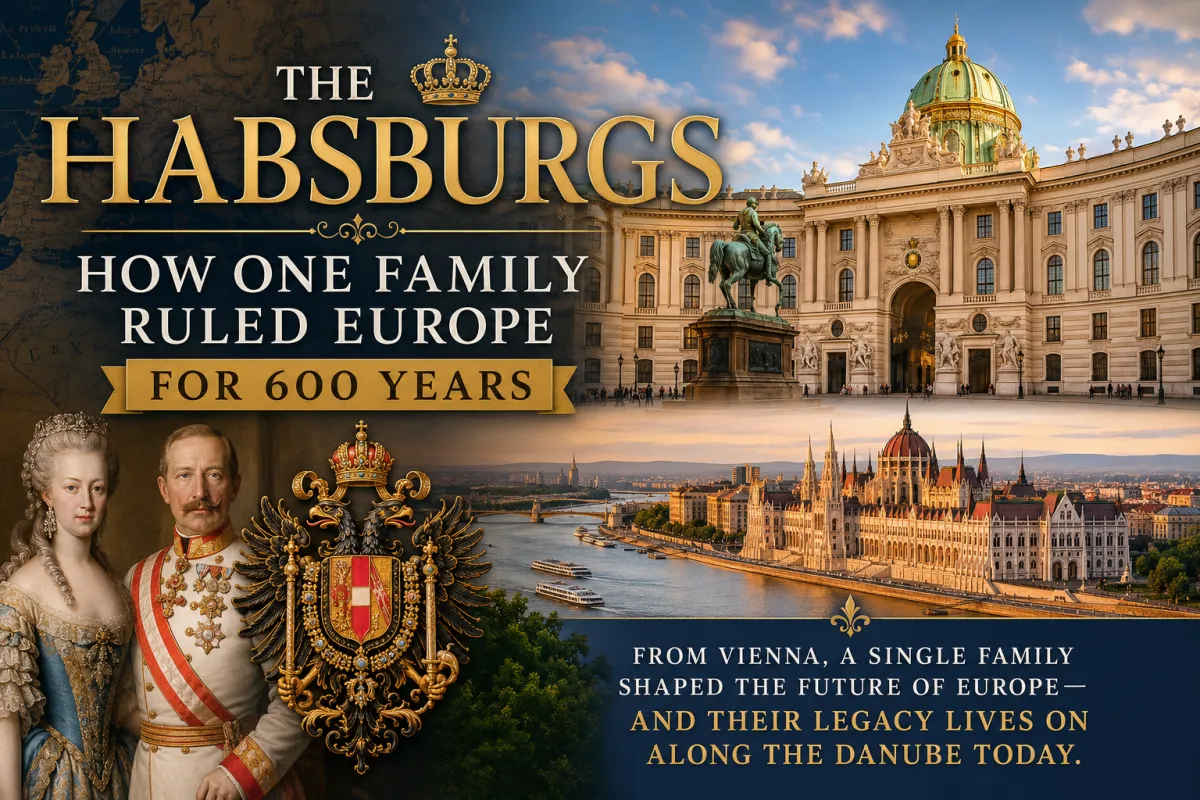
Beyond the Port™: The Habsburgs: How One Family Ruled Much of Europe for 600 Years
From their seat of power in Vienna, a single family shaped the future of Europe for centuries—and their legacy can still be seen throughout the Danube today.
Imagine if one family controlled much of Europe for hundreds of years.
Not a country.
Not a government.
A family.
For nearly 600 years, the Habsburg dynasty influenced the politics, culture, architecture, and future of Europe from their capital in Vienna. Even today, travelers visiting Austria, Hungary, Slovakia, and the Czech Republic encounter reminders of their remarkable story.
Understanding the Habsburgs helps explain why Vienna became one of Europe's most important cities—and why so many destinations along the Danube feel connected by a shared history.
The Family That Married Its Way Into Power
Unlike many empires that expanded primarily through conquest, the Habsburgs became famous for a different strategy.
Marriage.
A famous saying associated with the dynasty captured their approach:
"Let others wage war; you, happy Austria, marry."
Through carefully arranged marriages, the Habsburgs gained control of territories across Europe without always needing to win them on the battlefield. Over time, their influence stretched across modern-day Austria, Hungary, the Czech Republic, Croatia, parts of Italy, the Netherlands, and even Spain.
By combining diplomacy, wealth, and strategic alliances, they built one of the most powerful dynasties in European history.
Why Vienna Became the Center of an Empire
As Habsburg influence grew, Vienna transformed from a regional city into one of Europe's great capitals.
Emperors, nobles, artists, musicians, and scholars were drawn to the city. Wealth flowed into Vienna, funding grand palaces, churches, museums, and public spaces that still define the city's appearance today.
The Habsburgs understood that power wasn't measured only by armies. It was also reflected in culture.
They invested heavily in architecture, education, music, and the arts, helping turn Vienna into a center of European culture that rivaled Paris, London, and Rome.
Many of the landmarks visitors admire today exist because of the dynasty's desire to showcase the strength and sophistication of their empire.
Why Travelers Still Encounter the Habsburgs Everywhere
One reason the Habsburg story is so fascinating is that it never feels confined to a single city.
In fact, many travelers encounter Habsburg history throughout a Danube River cruise without realizing they're seeing pieces of the same story.
In Vienna, visitors tour the magnificent Schönbrunn Palace, the Habsburgs' lavish summer residence. They explore the Hofburg Palace, where emperors governed an empire that stretched across much of Europe.
A few days later, they may find themselves walking through Budapest, admiring grand boulevards, monumental government buildings, and architectural treasures that developed during the Austro-Hungarian Empire.
In Bratislava, travelers discover a city that once hosted the coronations of Hungarian kings under Habsburg rule.
Even Melk Abbey, one of the Danube's most iconic landmarks, flourished under the stability and influence of the dynasty's reign.
What makes this remarkable is that many guests experience these destinations as individual shore excursions.
Yet when viewed together, they reveal something much larger.
The palace in Vienna.
The coronation city of Bratislava.
The imperial grandeur of Budapest.
They are all chapters of the same story.
For many travelers, this realization transforms a beautiful itinerary into a far richer experience. What first appears to be a collection of stunning cities suddenly becomes a journey through one of Europe's most powerful dynasties.
This is why guided excursions and local historians can be so valuable. They help connect the dots between destinations, revealing the people and events that shaped the places we visit today.
Travelers seeking the deepest Habsburg experience will find it on classic Danube itineraries that include Vienna, Bratislava, and Budapest. Together, these cities formed some of the most important centers of Habsburg influence and offer an ideal introduction to the dynasty's lasting impact on Central Europe.
The End of an Empire
No empire lasts forever.
The Habsburg dynasty faced growing challenges during the late nineteenth and early twentieth centuries as nationalism spread across Europe.
The final chapter came with the outbreak of World War I. When the war ended in 1918, the Austro-Hungarian Empire collapsed, bringing centuries of Habsburg rule to a close.
The royal family lost its political power, and new nations emerged across Central Europe.
Yet while the empire disappeared, its cultural legacy remained.
Why Their Story Still Matters
Today, travelers don't need to memorize royal family trees or remember the names of every emperor to appreciate the Habsburg story.
What matters is understanding how one family helped shape the region you're exploring.
The palaces, churches, museums, city squares, and music halls found throughout Vienna and along the Danube didn't appear by accident. They are part of a legacy built over centuries.
When you understand the Habsburgs, many of Central Europe's most famous destinations suddenly make more sense.
The buildings become more than landmarks.
The cities become more than stops on an itinerary.
They become chapters in one of Europe's most remarkable stories.
Thinking About Visiting Vienna?
Travelers seeking the deepest Habsburg experience will find it on classic Danube itineraries that include Vienna, Bratislava, and Budapest. These cities served as important centers of Habsburg influence and help reveal how a single dynasty shaped much of Central Europe for centuries. Some itineraries also include Melk, adding another layer to the region's cultural and religious history.
🚢 Explore Danube River Cruise Itineraries
📅 Plan Your Journey with Voya Beyond Travel
Sometimes the best travel experiences begin with understanding the stories behind the places we visit.