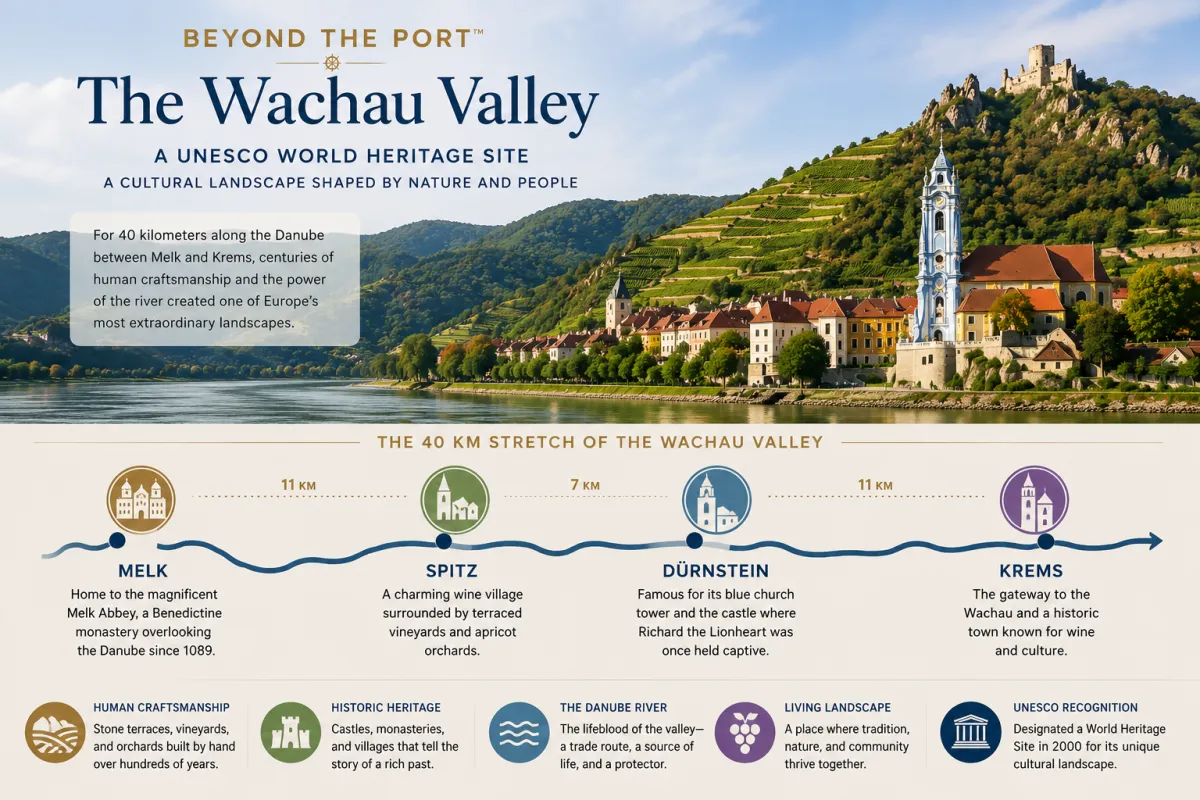
Beyond the Port™: How the Wachau Valley Became a UNESCO World Heritage Site
The Story Behind Austria's Most Beautiful River Landscape
Part of the Beyond the Port™ Danube Series
As your river cruise glides through the Wachau Valley, it's easy to assume the scenery has always looked this way.
The vineyards seem perfectly at home climbing the hillsides. Medieval villages appear to have grown naturally along the riverbanks, and centuries-old monasteries seem as though they've always watched over the Danube.
But here's the remarkable truth:
Almost everything you're looking at exists because generations of people deliberately shaped this landscape over nearly a thousand years.
The Wachau Valley isn't simply beautiful.
It's a masterpiece created by both nature and human hands.
That's why UNESCO designated it a World Heritage Site in 2000—not for a single castle, church, or monastery, but because the entire valley tells the story of how people and nature can exist in harmony over centuries.
What Does "World Heritage Site" Really Mean?
When many travelers hear the word UNESCO, they think of famous landmarks like the Great Wall of China or the Pyramids of Egypt.
The Wachau Valley is different.
UNESCO didn't recognize just one building or monument. Instead, it protected an entire cultural landscape—a place where the natural environment and human history are inseparable.
For roughly 25 miles (40 kilometers) between Melk and Krems, every vineyard, village, monastery, orchard, and castle contributes to a landscape that has evolved continuously for centuries while preserving its historic character.
It's one of the reasons cruising through the Wachau feels less like sightseeing and more like traveling through a living museum.
A Valley Built One Stone at a Time
One of the first things you'll notice from the sun deck is that the vineyards don't grow on gentle rolling hills.
They climb steep mountainsides.
At first glance, it almost seems impossible that grapes could grow here.
The secret lies beneath the vines.
Over centuries, local families built thousands of dry-stone retaining walls by hand, creating narrow terraces that transformed rugged slopes into productive vineyards. These walls not only made farming possible but also helped retain heat, improve drainage, and protect the soil from erosion.
Even today, many of these vineyards must still be harvested by hand because modern machinery simply can't operate on the steep terrain.
Those terraces aren't just beautiful—they're monuments to generations of hard work.
The Danube Made It All Possible
Without the Danube, there would be no Wachau.
For centuries, the river served as one of Europe's busiest trade routes, connecting kingdoms, monasteries, merchants, and cities.
Wine, salt, timber, spices, and countless other goods passed through the valley.
The river brought prosperity, but it also attracted powerful rulers eager to control commerce.
Castles were built on high cliffs overlooking the water, monasteries became centers of learning and agriculture, and villages flourished along the riverbanks.
As you cruise through the valley today, you're following the same route that merchants, pilgrims, emperors, and kings once traveled.
A Landscape That Refused to Modernize
Perhaps one of the most remarkable aspects of the Wachau Valley is what didn't happen.
Unlike many river corridors across Europe, the heart of the Wachau avoided large-scale industrial development.
There are no major factories interrupting the views.
No sprawling urban centers.
And perhaps most surprising to first-time visitors, no bridges crossing the central portion of the valley.
That lack of modern intrusion has preserved the uninterrupted views that make this stretch of the Danube so unforgettable.
It's also one of the reasons UNESCO recognized the valley as an outstanding example of a living cultural landscape rather than a preserved historical monument.
Still Alive After Hundreds of Years
The Wachau isn't frozen in time.
People still live here.
Families continue producing wine.
Apricot orchards still bloom each spring.
Church bells still ring through medieval villages.
River cruises now glide peacefully along waters once filled with merchant vessels.
This isn't history behind glass.
It's history still being lived every day.
That balance between preservation and everyday life is what makes the Wachau feel so authentic to visitors.
Why This Matters to River Cruisers
Understanding the Wachau's history changes the way you experience it.
Instead of simply admiring beautiful scenery, you begin noticing the craftsmanship behind every stone terrace, the purpose behind every castle ruin, and the generations of people who shaped the valley into what it is today.
The landscape becomes more than a postcard.
It becomes a story unfolding before your eyes.
👀 Watch for This From the Ship
As you sail through the Wachau Valley, look a little closer:
The countless dry-stone terraces built by hand.
Vineyards climbing slopes too steep for machinery.
Historic villages that have remained remarkably unchanged.
Castles positioned high above the river to oversee trade.
Monasteries surrounded by fertile farmland.
The uninterrupted views preserved by the absence of bridges through the valley's core.
Knowing the story behind these sights makes them even more meaningful.
Continue the Journey
In our next Beyond the Port™ article, we'll explore one of the Wachau's defining features—the dramatic vineyards that climb its steep hillsides and produce some of Austria's most celebrated white wines. You'll discover why this unique landscape has made the region a favorite among wine lovers and river cruisers alike.
Planning Your Danube River Cruise?
The Wachau Valley is included on many premium Danube itineraries, but each cruise line offers a different experience—from scenic cruising time and included excursions to wine tastings and land packages.
Whether you're comparing AmaWaterways, Avalon Waterways, or Celebrity River Cruises, I can help you choose the itinerary that best matches your interests, travel style, and budget.
📅 Schedule your complimentary river cruise consultation and let's start planning your journey through one of Europe's most remarkable landscapes.