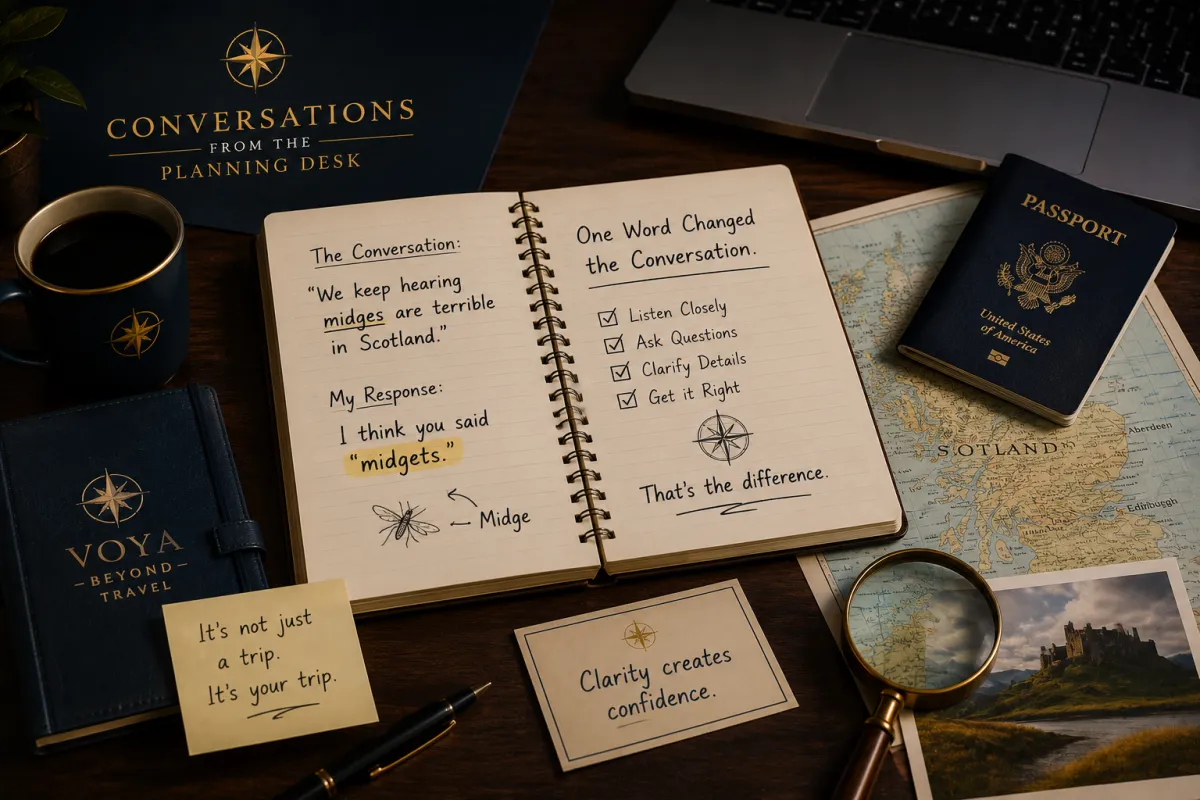
One Word Changed Our Scotland Conversation
Part of the Conversations from the Planning Desk series
Every unforgettable trip begins with a conversation.
This week, I was helping a couple compare two guided tours of Scotland and Ireland. They wanted to see the differences between CIE's Dream and Gold itineraries and were trying to decide whether May or September would be the better time to travel.
At first, the conversation was exactly what you would expect.
We talked about the advantages of traveling in May—spring flowers, longer days, milder temperatures, and generally smaller crowds. Then we compared that with September, when the landscapes begin taking on beautiful fall colors while still offering comfortable weather and fewer visitors than the height of summer.
Then they said something that completely changed the conversation.
"We're also trying to avoid the midges."
I'll admit it—I didn't hear midges.
I heard "midgets."
For a split second, my brain went in a completely different direction.
Trying to be helpful, I confidently continued explaining the differences between traveling in May and September—spring flowers, milder weather, fewer crowds—all while wondering what little people had to do with choosing the best time to visit Scotland.
The conversation continued, but something felt...off.
You know those awkward moments when you can tell you're not connecting on the same point? Their responses made me realize I had probably missed something, but I couldn't quite put my finger on it. Rather than making the conversation even more awkward, we wrapped up the call and agreed I'd continue researching the tours for them.
The moment we hung up, I knew I had to figure out what I'd missed.
I searched for "midges Scotland."
That's when everything clicked.
They hadn't been talking about midgets at all.
They were talking about midges—tiny biting insects that can be common in parts of Scotland during the warmer months, particularly in the Highlands and around lochs when the weather is warm, humid, and calm.
It was one of those moments that makes you laugh at yourself.
But it also reminded me why I love helping people plan travel.
No matter how much experience you have, every client brings new questions, new perspectives, and sometimes even teaches you something you never expected to learn.
Following Up Made All the Difference
As soon as I understood what they meant, I sent them a text.
I explained what midges are, when they're most active, and how choosing May instead of the peak summer months can often reduce the chances of encountering them. I also shared a few practical tips that experienced Scotland travelers use if they happen to visit during midge season.
Their response couldn't have been better.
They appreciated that I had taken the time to research the answer instead of simply guessing. That follow-up naturally led to even more questions about Scotland, itinerary options, and the differences between the Dream and Gold tours.
That awkward moment turned into an even better planning conversation.
The Conversation Went Much Deeper
Once we solved the mystery of the midges, we started talking about something many first-time land tour travelers don't think about.
Unlike an ocean cruise or a river cruise, guided land tours often involve changing hotels every day or two.
Some travelers absolutely love that pace because they get to experience as much as possible.
Others discover they'd rather spend two or three nights in one location, unpack once, and really get to know a destination instead of constantly moving.
That wasn't just a discussion about two itineraries.
It became a conversation about how they actually like to travel.
The Price Isn't Always the Budget
Another topic we explored was something I discuss with clients quite often.
Many guided land tours don't include every meal.
Some intentionally leave lunches and dinners open so you can experience local restaurants on your own.
Likewise, not every excursion is included.
Some companies build flexibility into the itinerary, allowing travelers to choose optional experiences that match their interests.
That's one reason I often create personalized excursion recommendations through my partner site. It allows clients to see what's available before they travel and build a realistic vacation budget based on the experiences they actually want—not just what's included in the tour price.
Sometimes a tour with a lower advertised price isn't actually less expensive once you factor in additional meals and optional experiences. Other times, that flexibility is exactly what a traveler wants.
There isn't a right or wrong answer.
There's only the itinerary that's the best fit for the person taking the trip.
The Lesson I Took Away
This conversation started with one simple question.
"Should we travel in May or September?"
Within a few minutes, we found ourselves discussing Scottish insects, hotel changes, tour pacing, included meals, optional excursions, and how different travel styles create completely different vacation experiences.
More importantly, it reminded me that being a travel advisor isn't about pretending to have every answer memorized.
It's about listening carefully, recognizing when something doesn't quite add up, doing the research, and making sure your clients receive the right information—even if that means following up after the conversation has ended.
Sometimes the best service isn't having an immediate answer.
Sometimes it's caring enough to find the correct one.
Travel Smarter Takeaway
The best vacations don't begin with booking.
They begin with conversations.
And sometimes, one misunderstood word can lead to better planning, a stronger relationship with your travel advisor, and a story you'll both laugh about later.
So...How Do People in Scotland Deal with Midges?
The good news is that midges are more of a nuisance than a reason to avoid Scotland altogether.
Locals simply plan around them.
Some of the most common strategies include:
Carrying insect repellent designed for midges, such as Smidge®, a product developed in Scotland.
Choosing windy locations whenever possible, since midges are weak flyers.
Planning longer outdoor activities during the middle of the day instead of dawn or dusk, when midges are often most active.
Wearing lightweight long sleeves if hiking in the Highlands during peak season.
Checking the Scottish Midge Forecast before spending extended time outdoors.
For most visitors, a little preparation is all it takes to keep midges from becoming more than a minor inconvenience.
About Conversations from the Planning Desk
Every article in this series is inspired by real travel planning conversations. Client names and identifying details have been changed or omitted to protect privacy, but the conversations, questions, and lessons are real.
My hope is that by inviting you behind the planning desk, you'll discover questions you may not have thought to ask—and become a more confident traveler because of it.