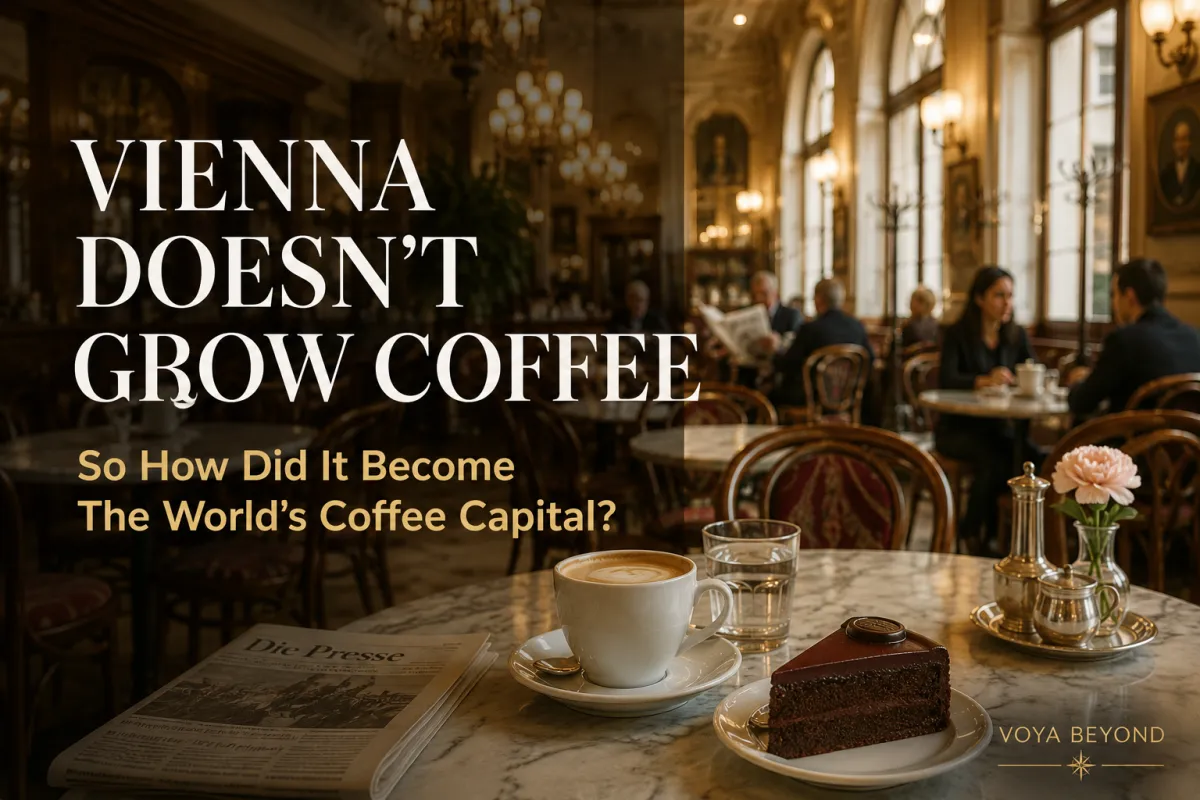
Beyond the Port™: Vienna Doesn't Grow Coffee. So How Did It Become the World's Coffee Capital?
Most people would expect the world's most celebrated coffee culture to be found in a country that actually grows coffee. Vienna proves otherwise.
A Cultural Tradition Built on a Bean That Doesn't Grow There
When most people think about coffee, they picture tropical mountains, coffee plantations, and countries whose economies have been shaped by growing beans for centuries.
Places like Colombia, Brazil, or Ethiopia.
Vienna is none of those places.
The Austrian climate is far too cold to grow coffee commercially. There are no sprawling coffee farms outside the city. No mountains covered in coffee trees. No harvest season celebrated by locals.
Viennese coffeehouse culture was added to Austria’s national inventory of intangible cultural heritage in 2011.
How did a city that grows no coffee become one of the most famous coffee destinations in the world?
The answer has very little to do with coffee itself.
Vienna Didn't Become Famous for Coffee
It Became Famous for What Happened Around Coffee
Many destinations celebrate the bean.
Vienna celebrates the experience.
For centuries, Vienna's coffeehouses functioned as something far greater than cafés. They became an extension of the city's living room.
People came to:
Read newspapers
Conduct business
Meet friends
Debate politics
Write books
Study philosophy
Discuss art and music
A single cup of coffee often purchased an entire afternoon.
The coffeehouse wasn't simply a place to stop.
It was a place to stay.
That simple idea transformed coffee from a beverage into a cultural institution.
The World's Slowest Coffee Culture
Walk into a traditional Viennese coffeehouse and you may notice something unusual.
Nobody seems to be in a hurry.
In many parts of the world, coffee is associated with speed.
Grab a cup.
Drink it quickly.
Move on.
Vienna developed the opposite philosophy.
Historically, guests were encouraged to linger. Newspapers were provided. Comfortable seating invited long conversations. Waiters understood that customers might spend hours at a table.
The coffee was important.
But the time spent enjoying it was equally important.
In a modern world that often rewards speed and efficiency, Vienna's coffeehouses feel almost rebellious.
A City Built on Conversation
Vienna spent centuries at the center of European culture.
As the capital of the vast Habsburg Empire, people from across Europe arrived bringing different languages, traditions, ideas, and ambitions.
The coffeehouse became a meeting place where those worlds could collide.
Artists discussed their latest work.
Writers drafted manuscripts.
Students debated ideas.
Musicians exchanged inspiration.
Politicians argued about the future.
Coffeehouses became informal classrooms, offices, newsrooms, and social clubs all at once.
They helped shape the intellectual life of one of Europe's most influential cities.
More Than Coffee and Cake
Of course, the coffee itself is excellent.
Traditional favorites include the Viennese Melange, often compared to a cappuccino, along with a variety of espresso-based specialties served with elegance and precision.
Most coffeehouses also serve classic Austrian desserts, including:
Sachertorte
Apple Strudel
Esterházy Torte
Seasonal pastries
Yet even these famous treats are part of something larger.
The ritual matters as much as the menu.
Coffee and cake become an invitation to slow down and enjoy the moment.
Why River Cruise Travelers Fall in Love with Vienna
Many Danube River cruise itineraries include Vienna because of its grand palaces, classical music heritage, and imperial history.
Those attractions are certainly worth experiencing.
But many travelers discover that their favorite memory isn't found inside a museum or palace.
It's sitting in a coffeehouse.
Watching locals.
Listening to conversations.
Enjoying a slice of cake.
Feeling, for a moment, less like a tourist and more like part of the city.
These are the experiences that help travelers understand a destination beyond its landmarks.
Vienna is featured on many Danube River cruise itineraries, though each cruise line offers a slightly different experience. Some focus more heavily on history and cultural immersion, while others emphasize active excursions, culinary experiences, or luxury amenities.
If Vienna has sparked your curiosity, you can explore available Danube River cruise itineraries here:
👉 Explore Danube River Cruise Options
What Vienna's Coffeehouses Reveal About the City
The coffeehouse tells you something important about Vienna.
This is a city that values culture.
It values conversation.
It values ideas.
And perhaps most importantly, it values taking time to enjoy life.
That philosophy can be seen everywhere—from the city's architecture and music halls to its parks, museums, and neighborhoods.
The coffeehouse simply happens to be one of the most welcoming places to experience it.
Final Thoughts
Vienna doesn't grow coffee.
Yet it became one of the world's great coffee capitals.
Not because of the beans.
Not because of the harvest.
Not because of the farms.
But because Vienna transformed coffee into something bigger: a tradition, a gathering place, and a way of life.
That social tradition helps explain its place in Austria’s national inventory of intangible cultural heritage.
It isn't really about coffee at all.
It's about people.
And in a world that often moves too fast, that's a tradition worth preserving.
About Visiting Vienna
Vienna is one of the highlights of many Danube River cruise itineraries. Whether you're drawn by imperial history, classical music, Christmas markets, or simply the chance to experience one of the world's most unique coffee cultures, the city offers travelers an opportunity to slow down and experience Europe from a different perspective.
Talk through your travel ideas
Would you like time for Vienna’s cafés and cultural experiences? We can discuss itinerary choices and a comfortable pace for your visit.
Schedule a personal travel consultation with Brandon Sams, or share your ideas on the inquiry form.