Beyond the Port™: Why Vienna Feels Different Than Any Other City in Europe
Most cities can be described in a few words.
Paris is romance.
Venice is canals.
Amsterdam is bicycles.
Vienna is much harder to explain.
That's because Vienna isn't just one city.
It's several civilizations layered on top of one another, each leaving its mark and creating a place unlike anywhere else in Europe.
Walk through Vienna today and you'll encounter Roman ruins beneath modern streets, imperial palaces built by one of Europe's most powerful dynasties, coffeehouses inspired by centuries-old traditions, world-famous music, contemporary art museums, and Christmas markets that transform the city every winter.
Vienna is not frozen in time.
It is a living record of how European civilization evolved over nearly two thousand years.
The Roman City Beneath Vienna
Long before Vienna became Austria's capital, it was a Roman frontier settlement known as Vindobona.
Roman soldiers once stood guard here along the Danube, protecting the northern edge of the Roman Empire.
Today, visitors can still see archaeological remains hidden among the city's elegant streets.
Most travelers walk right past them without realizing they are looking at nearly two thousand years of history.
Before emperors ruled from Vienna, Roman legionaries called this place home.
The Capital of an Empire
For centuries Vienna served as the center of the Habsburg Empire.
At its height, decisions made in Vienna influenced millions of people across Central Europe.
The empire stretched across lands that today include Austria, Hungary, the Czech Republic, Slovakia, Croatia, Slovenia, and parts of several other countries.
The magnificent Hofburg Palace, grand boulevards, statues, and monumental buildings were not simply constructed to impress visitors.
They were built to communicate power.
Walking through Vienna today feels like walking through the headquarters of a European superpower.
The Coffee That Changed a City
One of Vienna's most beloved traditions began with coffee.
According to local legend, coffee beans left behind after the failed Ottoman siege of Vienna helped inspire the city's famous coffeehouse culture.
Whether every detail of the story is true matters less than what followed.
Vienna transformed coffee into something more than a beverage.
Coffeehouses became gathering places where artists, musicians, philosophers, politicians, and ordinary citizens spent hours discussing ideas.
Even today, sitting in a Viennese café feels less like ordering a drink and more like participating in a centuries-old tradition.
A City Designed for Beauty
One thing becomes obvious after spending time in Vienna:
Very little feels accidental.
The grand public squares.
The elegant architecture.
The carefully planned parks.
The historic horse-drawn carriages.
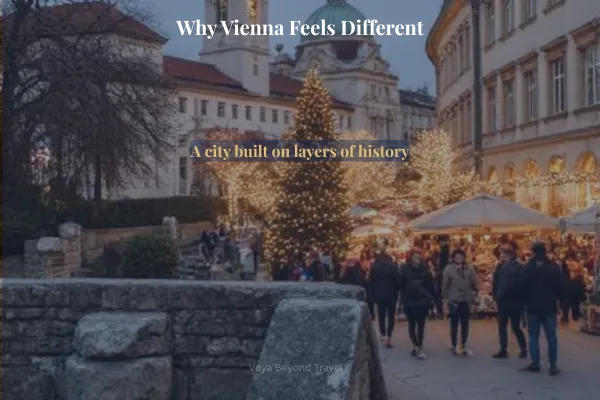
Even the city's Christmas markets.
Vienna has spent centuries intentionally creating beautiful public spaces.
The result is a city that feels remarkably elegant without feeling artificial.
Beauty is not an attraction here.
It is part of daily life.
Where Tradition Meets Modern Life
Many first-time visitors expect Vienna to feel like a museum.
Instead, they discover a modern city.
Contemporary art museums stand beside imperial palaces.
Glass buildings reflect Gothic cathedrals.
Young professionals gather in trendy districts only blocks from centuries-old landmarks.
Vienna never abandoned its history.
It simply built upon it.
The city proves that preserving the past and embracing the future do not have to be opposing ideas.
The Christmas Markets Reveal Everything
Perhaps nowhere is Vienna's character more visible than during the Christmas season.
Many travelers assume Christmas markets are simply collections of holiday stalls.
In Vienna, they are carefully planned experiences.
Architects, designers, urban planners, artisans, and city officials work together to create markets that balance beauty, sustainability, crowd flow, tradition, and local culture.
Some markets feel imperial.
Others feel modern.
Some attract visitors from around the world.
Others are beloved by local residents.
Together they reveal something important about Vienna:
The city still values craftsmanship, public space, and creating meaningful experiences.
Why Vienna Feels Different
Most cities are defined by a single era.
Vienna is defined by all of them.
Roman soldiers.
Imperial rulers.
Coffee merchants.
Composers.
Artists.
Architects.
Modern designers.
Their stories overlap throughout the city.
That is why Vienna feels different.
It is not simply a destination on a map.
It is one of the few places in Europe where you can see two thousand years of culture layered together in a single afternoon.
And once you begin to notice those layers, Vienna becomes far more than a stop on a river cruise.
It becomes a place you want to understand.
Talk through your travel ideas
Thinking about including Vienna in your journey? We can compare river cruises, tours and time in the city around your interests and priorities.
Schedule a personal travel consultation with Brandon Sams, or share your ideas on the inquiry form.