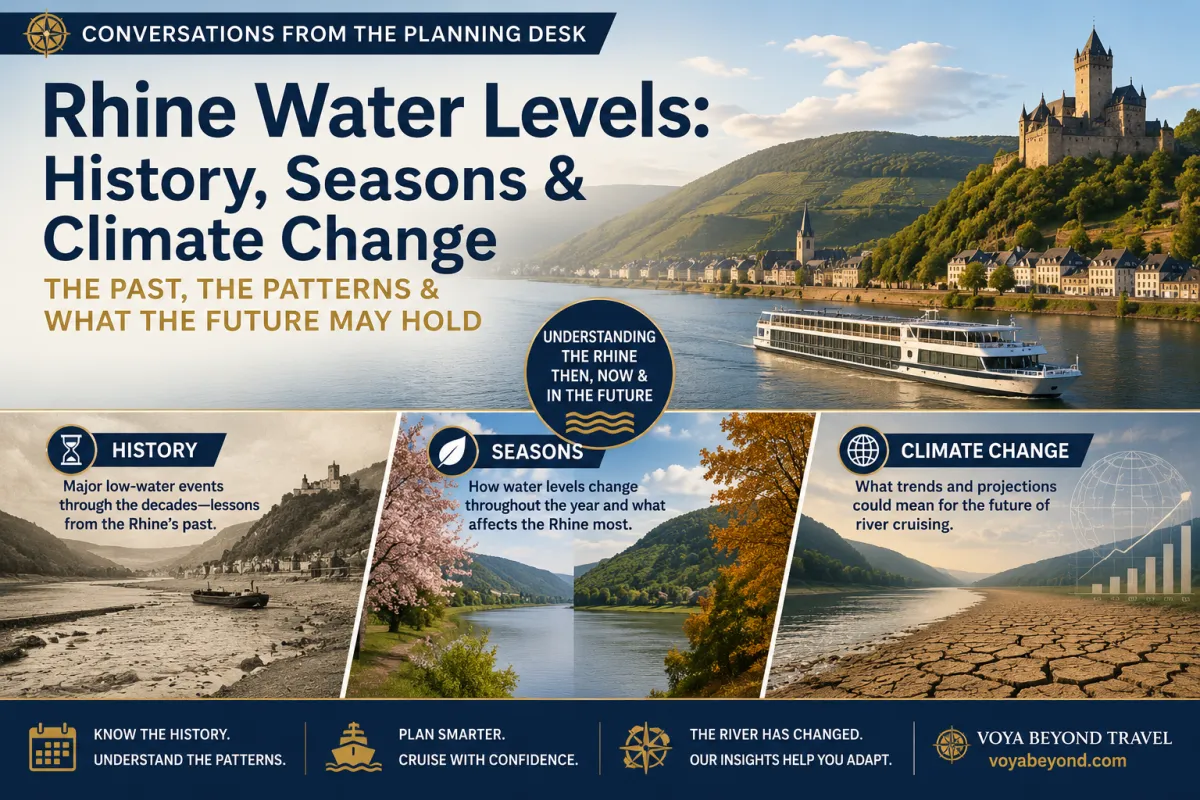
Rhine Water Levels: History, Seasons & Climate Change
Conversations from the Planning Desk
Rhine Water Levels: History, Seasons & Climate Change
When travelers hear about low water on the Rhine, two questions often follow:
“Is this something new?”
And:
“Is there a better time of year to cruise if I'm worried about water levels?”
Those questions require looking beyond today's Kaub reading.
The Rhine has a long history of both high- and low-water events. At the same time, a changing climate can affect the frequency, duration and severity of future extremes.
Understanding both gives us a much better picture of what Rhine travelers should—and shouldn't—worry about.
In Parts 1 and 2 of this series, we looked at what Kaub water-level readings actually mean and why different vessels can respond differently to the same river conditions. Now we're stepping back from today's gauge reading to look at the bigger picture: the Rhine's history, its seasonal patterns and how those patterns may change in the future.
📚 Is Low Water on the Rhine Something New?
No.
And this historical perspective is important.
The International Commission for the Protection of the Rhine (ICPR) analyzed historical Rhine discharge records and found that low-water periods during the first half of the 20th century were actually more pronounced and lasted longer than those during the following 50 years.
Kaub itself has an extraordinarily long observational history.
Regular observations began in 1856.
Germany's Federal Institute of Hydrology records significant historical low-water events including:
1947 • 1949 • 1954 • 1959 • 1962 • 1971 • 1972 • 2018
among others.
So seeing low water on the Rhine today doesn't mean we're witnessing something the river has never experienced before.
But history is only one part of the story.
📉 What Does an Extreme Year Look Like?
To understand how an extreme low-water year can develop, 2018 provides a useful modern example.
The important part isn't simply how low the Rhine became.
It's how the conditions developed over time.
The Rhine basin experienced a pronounced precipitation deficit from February through November 2018.
Conditions progressively worsened, with the low-water event reaching its greatest extent during October and November.
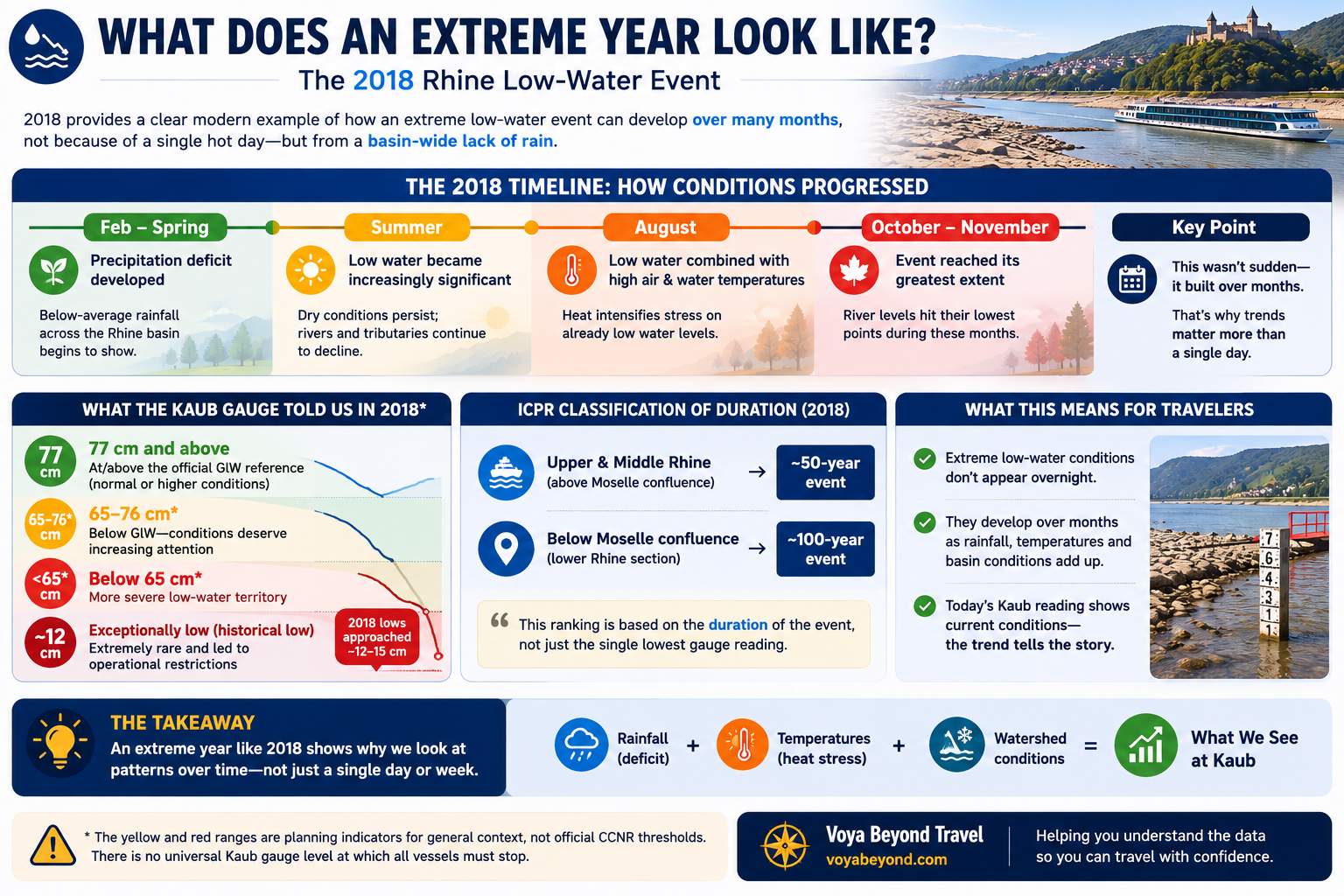
The 2018 Rhine low-water event developed over many months. The ICPR classified its duration at roughly a 50-year event on the Upper and Middle Rhine and approximately a 100-year event below the Moselle confluence.
The duration of the event was significant.
According to the ICPR, the 2018 low-water event on the Upper and Middle Rhine was roughly a 50-year event based on duration.
Below the Moselle confluence, its duration was classified at approximately a 100-year recurrence interval.
Why does this matter to travelers?
Because it shows why we shouldn't judge an upcoming Rhine cruise simply by today's weather—or assume that a few hot days automatically mean there will be a navigation problem.
Extreme low-water conditions can develop over months.
Rainfall, temperatures, snowmelt and conditions throughout the Rhine watershed all contribute to what eventually happens on the river.
The takeaway: A single day's Kaub reading gives us current conditions. The trend leading up to your sailing gives us much more context.
🌱 When Is the Best Time to Cruise the Rhine?
This is where I would be careful about anyone promising you a “safe month.”
There isn't one.
The Rhine responds to conditions across a very large watershed.
Rainfall, snowmelt, temperature and prolonged dry or wet periods can all influence river levels.
Instead of labeling individual months as safe or unsafe, it is more useful to understand how conditions can change throughout the year.
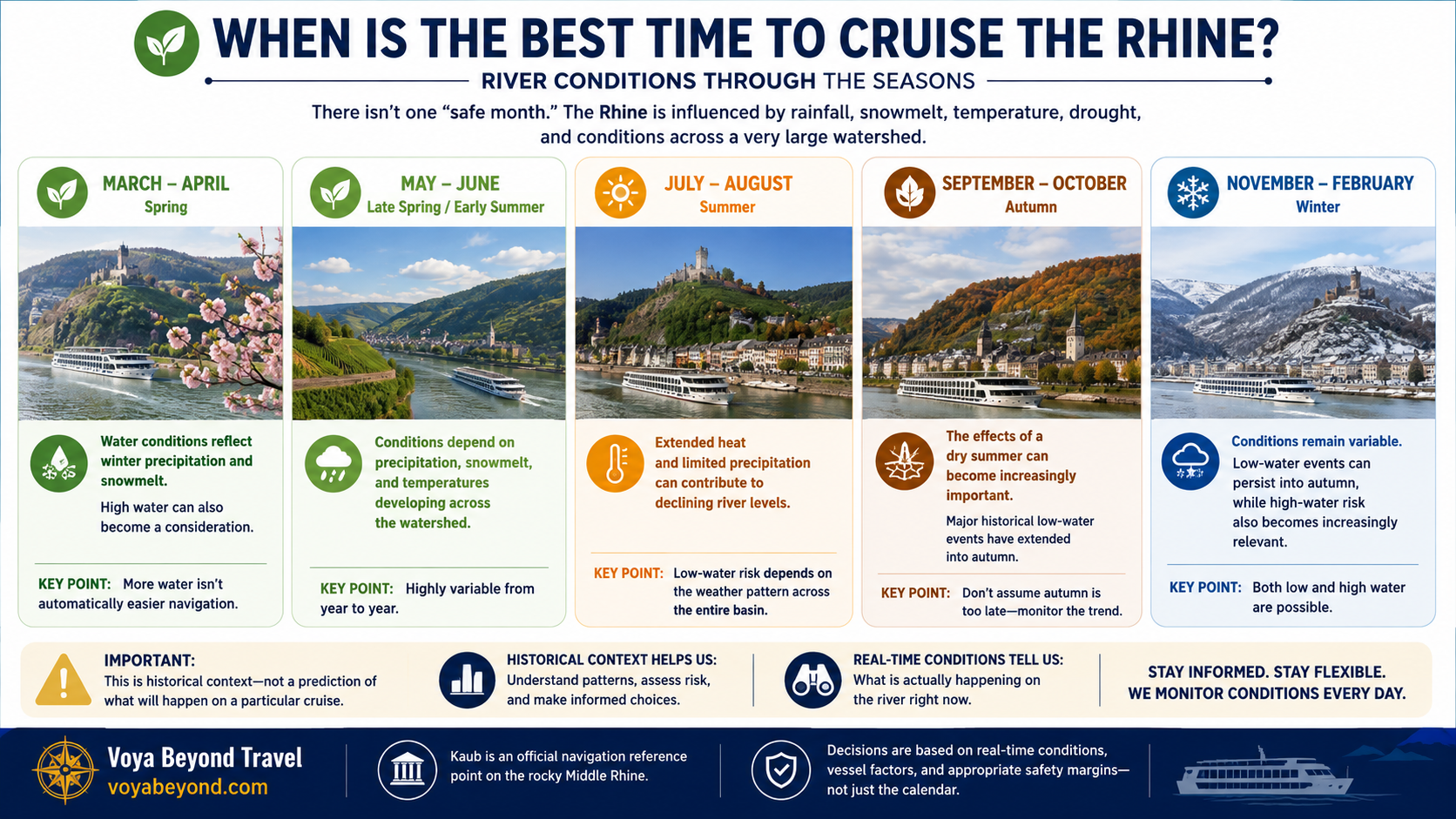
Rhine conditions vary throughout the year. Historical seasonal patterns provide useful context, but no month guarantees ideal river levels and actual navigation conditions must be evaluated in real time.
What should travelers take from this?
Spring isn't automatically better because there's more water.
High water can create its own navigation concerns.
Summer isn't automatically a problem.
Low-water risk depends on the weather pattern developing across the Rhine basin.
And autumn isn't automatically too late.
What matters is whether prolonged dry conditions developed during the preceding months.
That's why historical patterns are useful for understanding risk, but they cannot tell us exactly what the Rhine will look like during a future sailing.
Historical context helps us choose and prepare. Real-time conditions tell us what's actually happening.
🌍 What About Climate Change?
Historical low-water events don't mean we should dismiss what is happening to the Rhine today.
The Rhine has always experienced natural periods of both high and low water, but climate change can alter how frequently those extremes occur, how long they last and how severe they become.
The latest ICPR climate analysis points toward an important seasonal shift.
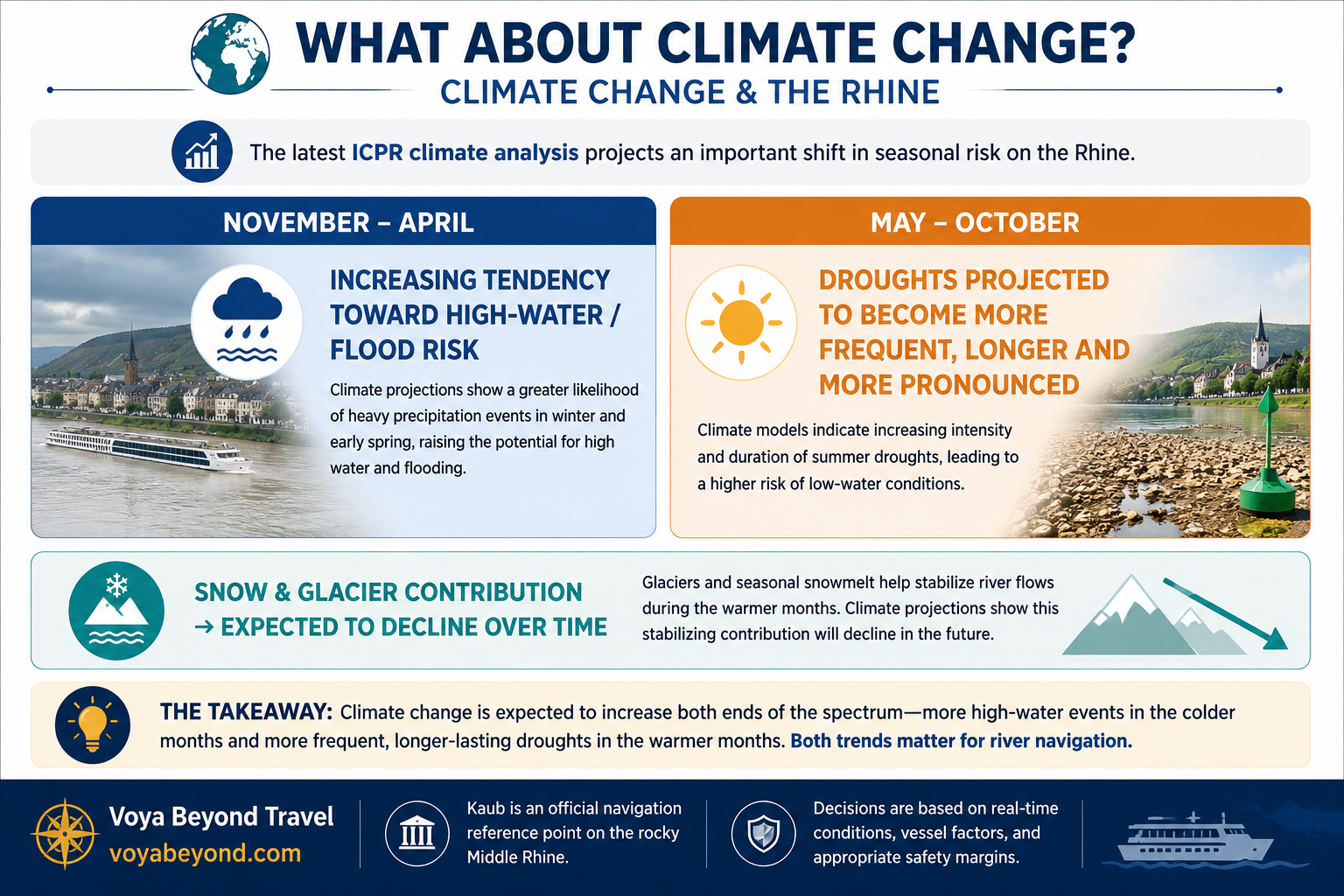
NOVEMBER–APRIL
🌧️ Increasing high-water / flood considerations
MAY–OCTOBER
☀️ Droughts projected to become more frequent, longer and more pronounced
Another factor is changing snow and glacier melt.
❄️ Snow and glacier contribution is expected to decline over time.
Their stabilizing contribution to Rhine flows during the warmer part of the year is expected to decline over time.
Two Things Can Be True at the Same Time
The Rhine has experienced significant low-water events throughout its recorded history.
And:
Climate change can increase the likelihood, duration or severity of future drought and low-water conditions.
Understanding both pieces of the story gives travelers better context.
A low Rhine isn't automatically evidence of an unprecedented event—but historical low water also doesn't mean future conditions will behave exactly as they did in the past.
What does this mean for a river cruise traveler?
It reinforces the same principle we've been using throughout this series:
Historical data helps us understand the river. Real-time conditions help us understand your particular sailing.
💧 Why Protecting the Rhine Matters
This conversation is bigger than river cruising.
The Rhine supports communities, ecosystems, drinking water, industry, agriculture, energy, transportation and tourism.
Low-water events affect more than passenger ships.
The ICPR notes impacts on navigation, energy production, industry and agriculture.
Understanding what is happening to the Rhine—and supporting efforts to preserve and adapt this river system—matters to everyone who depends upon it.
🧭 Bringing the Entire Series Together
After all the history, numbers, gauges and climate projections, what should a traveler actually remember?
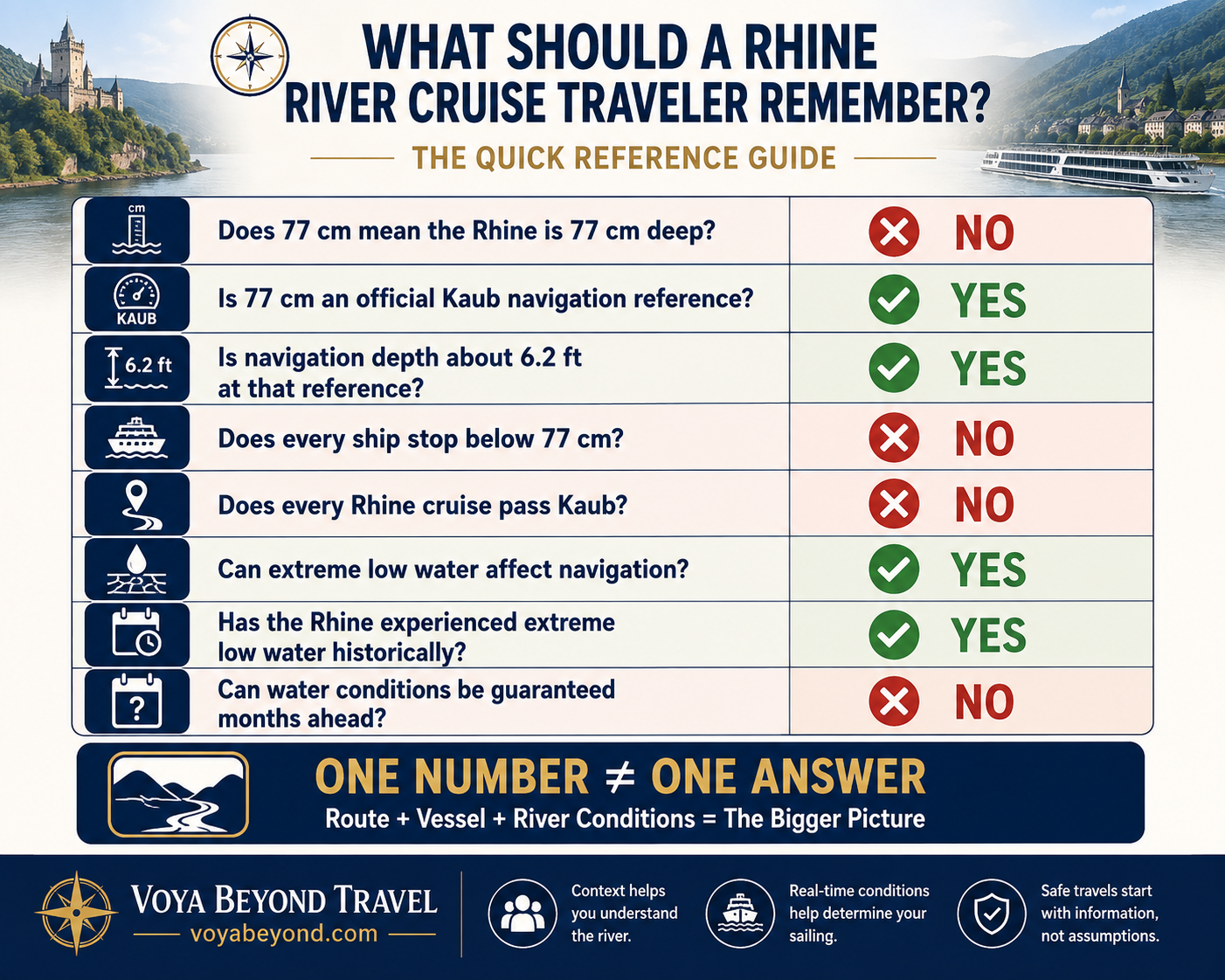
The Most Important Thing to Remember
A river is a dynamic environment.
Historical data can tell us what has happened before.
Climate projections can help us understand how risks may change.
Seasonal patterns can give us context.
And today's gauge readings can tell us what's happening right now.
But none of those individually guarantees what conditions will be during a particular river cruise months in the future.
That's why I prefer to give travelers context rather than guarantees.
Before You Worry About Your Rhine Cruise
Go back to three basic questions:
1. Does my itinerary actually travel through the section of the Rhine I'm hearing about?
2. What does the reported water level actually mean for navigation?
3. What are the real conditions and trends as my sailing approaches?
Those questions give us considerably more useful information than simply seeing a water-level number in a headline.
Explore the Rhine Water Levels Series
Part 1: Should I Be Worried About Rhine River Water Levels?
Understanding Kaub, what a 77 cm reading actually means and why one number doesn't determine your cruise.
Part 2: How Low Can the Rhine Go?
How ship design, navigation depth, vessel draft and real-time conditions affect navigation.
Part 3: Rhine Water Levels: History, Seasons & Climate Change
You're reading Part 3.
From the Planning Desk
River cruising involves more than choosing a ship and finding the lowest fare.
Route, season, river conditions and the characteristics of the vessel can all matter.
My job isn't to promise that Mother Nature will cooperate.
It's to help you understand the information that's available, put it into context and make a more informed decision about your vacation.
If you're considering a Rhine river cruise and water levels are a concern, I can help you look at your actual itinerary and determine how the sections of the river you're traveling relate to current conditions.
Brandon Sams
Travel Consultant
European River Cruise Specialist (ERCS)
650-541-9409