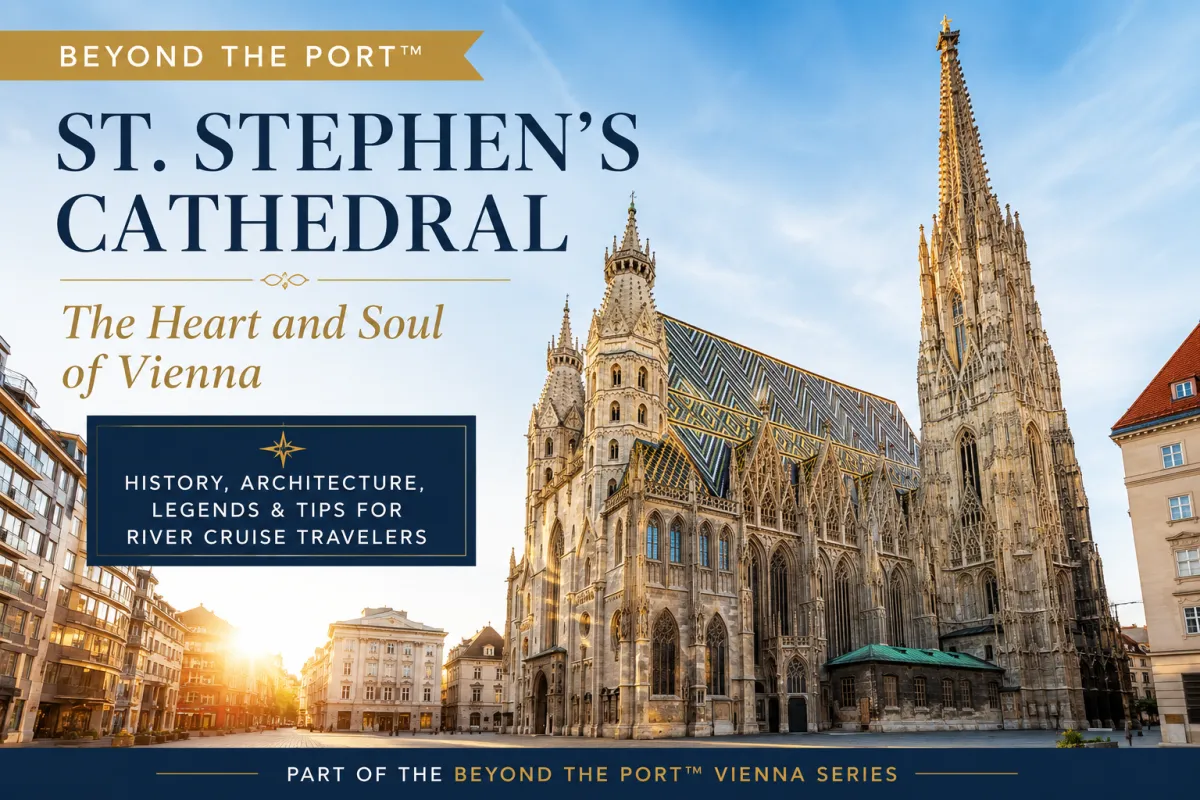
Beyond the Port™: St. Stephen's Cathedral: The Heart and Soul of Vienna
Part of the Beyond the Port™ Vienna Series
Some landmarks define a city.
In Paris, it's the Eiffel Tower.
In London, it's Big Ben.
In Vienna, it's St. Stephen's Cathedral.
Rising above the rooftops of Vienna's historic center for more than 850 years, St. Stephen's Cathedral has witnessed the rise and fall of empires, survived wars, celebrated royal weddings, and welcomed millions of visitors from around the world. Its colorful tiled roof, soaring Gothic spire, and commanding presence have made it the unmistakable symbol of Austria's capital.
For guests arriving on a Danube River Cruise, chances are your first walking tour through Vienna will lead directly to Stephansplatz, where this magnificent cathedral stands at the very heart of the city.
Before exploring St. Stephen's Cathedral, it's worth understanding why Vienna feels different than any other European capital. Its centuries of imperial history, music, architecture, and café culture all come together in the streets surrounding the cathedral.
Understanding its history makes that first glimpse even more unforgettable.
A Church Built Over Centuries
The story of St. Stephen's Cathedral began in the 12th century, when Vienna was still a relatively small medieval settlement.
Construction started in 1137, and over the following centuries the church expanded, evolved, and was rebuilt into the magnificent Gothic cathedral visitors admire today.
Like many of Europe's great cathedrals, it wasn't constructed by a single generation. Instead, each era added its own architectural touches, resulting in a masterpiece that reflects nearly 300 years of craftsmanship.
Today, the cathedral remains one of the most important religious and cultural landmarks in Austria.
The Roof Everyone Remembers
One of the cathedral's most recognizable features isn't its towers—it's its roof.
More than 230,000 glazed ceramic tiles create dazzling geometric patterns that shimmer differently throughout the day.
On one side, the tiles form the double-headed eagle that once represented the Habsburg Empire.
On the other, they display the coats of arms of the City of Vienna and the Republic of Austria.
Few churches in Europe are instantly recognizable from above, but St. Stephen's colorful roof has become one of Vienna's defining images.
The South Tower: Vienna's Medieval Skyscraper
Standing nearly 450 feet (137 meters) tall, the South Tower dominated Vienna's skyline for centuries.
Completed in 1433, it remained one of the tallest structures in Europe and served as both a religious symbol and a practical lookout over the growing city.
Visitors willing to climb its 343 steps are rewarded with panoramic views across Vienna's historic center, offering a unique perspective over the palaces, rooftops, and grand boulevards that make the city so distinctive.
Meet the Pummerin
Inside the North Tower hangs one of Europe's largest church bells.
Known as the Pummerin, it weighs more than 20 tons and has become one of Austria's national symbols.
The original bell was cast using metal from cannons left behind after the Ottoman siege of Vienna in 1683, transforming instruments of war into a symbol of peace.
Although the original bell was destroyed during World War II, today's Pummerin continues the tradition by ringing on special national occasions and New Year's celebrations.
Hidden Beneath the Cathedral
While most visitors admire the soaring ceilings and intricate stonework above, another fascinating part of the cathedral lies underground.
The catacombs contain centuries of history, including the remains of bishops, members of the Habsburg family, and thousands of Viennese citizens.
Guided tours offer a fascinating look into Vienna's medieval past while highlighting the cathedral's role as both a place of worship and an important part of the city's history.
For many visitors, the catacombs become one of the most memorable—and surprising—parts of their visit.
Surviving War
Near the end of World War II, St. Stephen's Cathedral came dangerously close to being lost forever.
In April 1945, fires spread through nearby buildings and reached the cathedral, causing the magnificent timber roof to collapse.
The iconic Pummerin Bell crashed to the ground, shattering into pieces.
For many Viennese, the destruction symbolized the devastation of the war itself.
Yet almost immediately after the conflict ended, the people of Austria began rebuilding their beloved cathedral.
Remarkably, St. Stephen's reopened in 1952 after an extraordinary restoration effort, standing today as both a symbol of resilience and national pride.
The Heart of Vienna
Unlike many famous European landmarks that sit apart from daily life, St. Stephen's Cathedral remains woven into the rhythm of modern Vienna.
Street musicians perform nearby.
It's no surprise that music fills these streets. Vienna's reputation as one of the world's greatest musical cities was shaped by centuries of composers, concert halls, and imperial patronage.
Horse-drawn carriages pass through Stephansplatz.
Locals meet friends at the surrounding cafés.
Visitors begin shopping along Kärntner Straße.
Whether you're exploring independently or participating in a guided shore excursion, chances are you'll spend time in the lively square surrounding the cathedral.
It's more than a tourist attraction—it's Vienna's gathering place.
Visiting During Your Danube River Cruise
Before planning your Vienna visit, check your sailing’s excursion options, any additional charges and the time available ashore. Included tours and free time vary by itinerary.
Many shore excursions also include time at Schönbrunn Palace, the magnificent summer residence of the Habsburg rulers and one of Vienna's most visited attractions.
St. Stephen's Cathedral is usually one of the first major landmarks you'll encounter.
If your schedule allows, consider spending extra time here to:
Climb the South Tower for panoramic city views.
Visit the catacombs on a guided tour.
Admire the colorful tiled roof from several angles around Stephansplatz.
Step inside to appreciate the cathedral's soaring Gothic architecture.
Pause at one of the nearby cafés and enjoy the atmosphere of Vienna's historic center.
Vienna's historic cafés are part of a coffeehouse tradition entered in Austria’s national inventory of intangible cultural heritage in 2011.
Even if you only have a few hours in Vienna, St. Stephen's Cathedral offers an unforgettable introduction to the city's history and culture.
Why It Matters
Every city has a landmark that tells its story.
For Vienna, that landmark is St. Stephen's Cathedral.
It has stood through medieval kingdoms, the reign of the Habsburg dynasty, world wars, and the birth of modern Austria, all while remaining the spiritual and cultural heart of the city.
Together with Schönbrunn Palace, Vienna's coffeehouses, and its rich musical heritage, St. Stephen's Cathedral tells the story of a city unlike any other along the Danube.
For river cruise travelers, it's often the place where Vienna truly comes alive—not just as a destination on an itinerary, but as a city with nearly nine centuries of history waiting to be discovered.
That's what makes St. Stephen's Cathedral much more than a beautiful church.
It's the soul of Vienna.
Talk through your travel ideas
Want meaningful time in Vienna as part of your trip? We can compare river-cruise itineraries and city stays around the experiences you most want to enjoy.
Schedule a personal travel consultation with Brandon Sams, or share your ideas on the inquiry form.