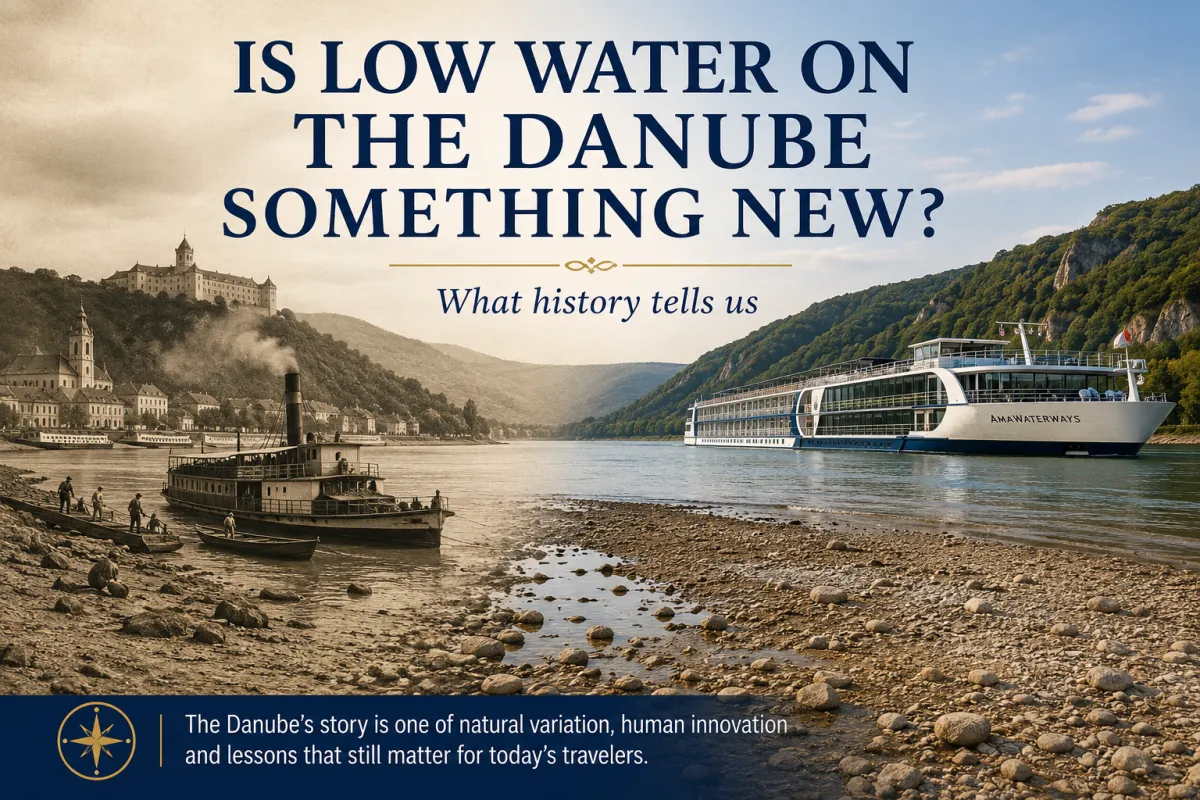
Danube Low Water: Is It New? A Look at the River's History
Is Low Water on the Danube Something New?
DANUBE WATER LEVELS SERIES · ARTICLE 2 OF 7
Low-water headlines can make it sound as though the Danube has suddenly become unreliable.
It hasn’t.
The Danube has always risen and fallen with seasons, snowmelt, rainfall and drought. What has changed is the scale of modern dependence on the river—and growing concern about longer, more frequent or more volatile low-water periods.
New to this Danube Water Level Series?
If you haven't read the first article, Understanding Danube Water Levels: The Gauges That Tell the Story explains how river gauges work, why a gauge reading is not the same as navigable water depth, and why conditions can vary so much from one section of the Danube to another.
Previous in the series — Article 1 of 7: Understanding Danube Water Levels →
A river that has never stood still
For centuries, the Danube was a shifting river of channels, islands, wetlands, sandbars and floodplains. Navigation depended heavily on season and local knowledge.
As commerce grew, governments increasingly reshaped the river. Channels were straightened, banks reinforced, floodplains separated by dikes, shallow areas dredged, and dams and locks constructed.
The goal was understandable: make navigation safer, protect cities from floods, generate electricity and create more predictable conditions.
But even an engineered river remains a river.
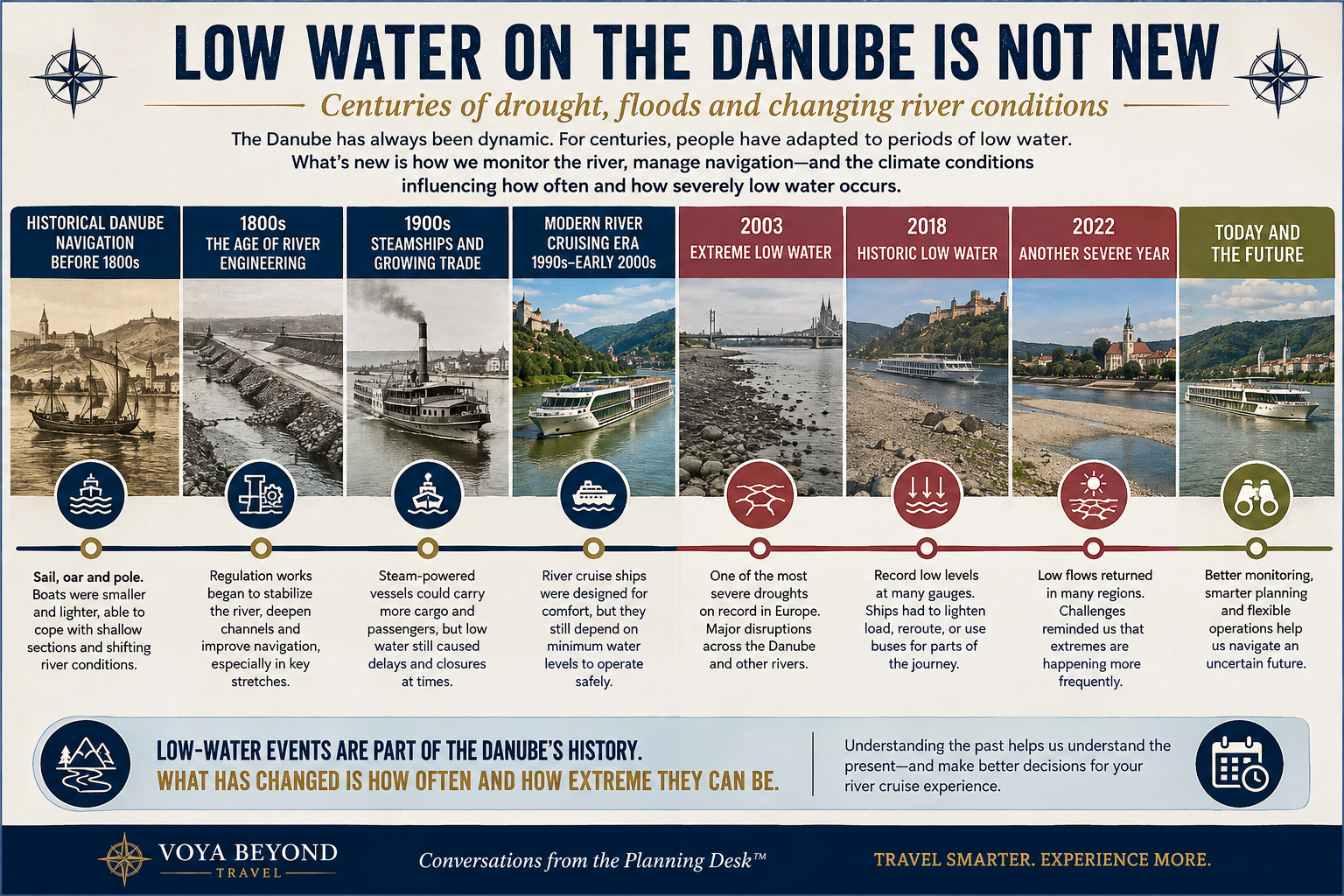
Low water existed long before river cruising
Historical Danube records contain extreme lows from decades before today’s passenger-cruise industry. The Danube Commission’s long-term statistical tables include historic minimums dating well back into the twentieth century at numerous stations.
So when someone asks whether climate change “created” low water on the Danube, the accurate answer is no.
Drought is part of the river’s history.
The more useful question is whether the frequency, duration and severity of difficult low-water periods are changing.
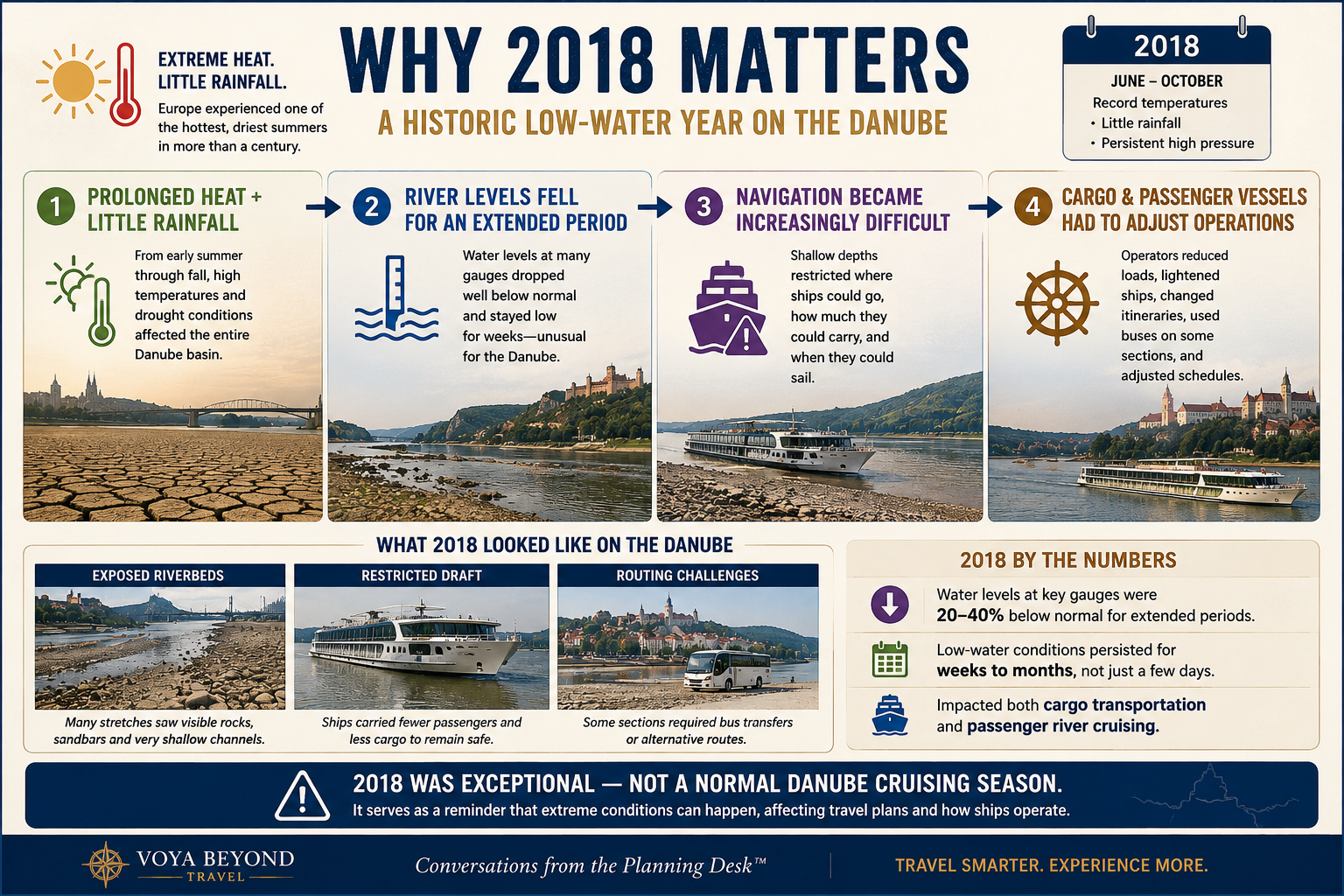
2018 became a modern warning
The European drought of 2018 is one of the important recent reference years for inland navigation. Long periods of low water affected major European rivers, including the Danube.
The Danube Commission continues to use 2018 as a comparison year in its navigation statistics.
Then came 2022.
The Commission’s 2022 statistical yearbook specifically compares the number of days below Low Navigable Water Level at selected stations in 2018 and 2022, underscoring how important both years were for navigation.
The Lower Danube shows why duration matters
A particularly useful example comes from Bulgaria’s Danube navigation reporting.
For the Bulgarian section, authorities reported:
2020: 21 days below Low Navigable Water Level
2021: 53 days
2022: 111 days
2023: 36 days
2024: 30 days
2025: 116 days
That sequence tells a much more useful story than a single dramatic photograph.
The river did not simply get lower every year. Conditions improved significantly in 2023 and 2024 before becoming exceptionally difficult again in 2025.
River hydrology is variable.
Why 2022 deserves attention
In 2022, the Danube experienced another significant period of low water across parts of the river.
The important point isn't that 2022 was identical to 2018. It wasn't. What matters is that another major low-water event occurred only a few years later, again affecting navigation and drawing attention to how prolonged heat and limited rainfall can influence the river.
For travelers, 2022 reinforced an important lesson:
One extreme year can be an exception. Repeated extreme years make the longer-term pattern worth watching.
That doesn't mean low water will affect every season—or every Danube cruise. It means historical conditions, recent extremes and changing weather patterns all need to be considered together when trying to understand the river.
Climate change enters the conversation
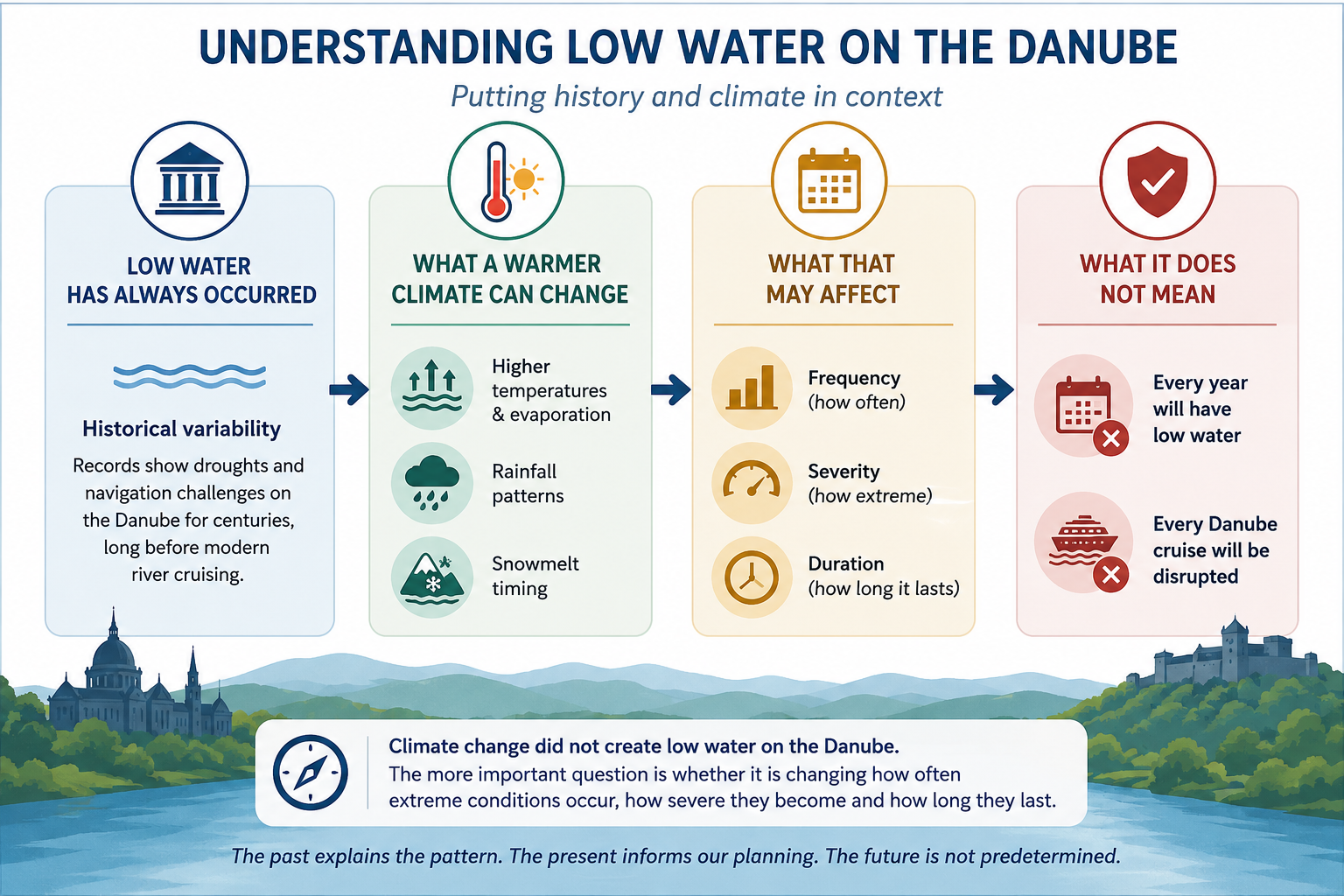
Low water on the Danube is not new. Historical records show that droughts and difficult navigation conditions occurred long before modern river cruising—and long before today's climate concerns.
What may be changing is the frequency, severity and duration of extreme conditions.
Warmer temperatures can increase evaporation, while changes in rainfall and snowmelt can affect when and how much water reaches the Danube and its tributaries.
That does not mean every summer will bring low water, or that every Danube cruise will experience a disruption. River conditions still vary considerably from year to year and from one section of the Danube to another.
Climate change did not create low water on the Danube. The more important question is whether it is changing how often extreme conditions occur, how severe they become and how long they last.
Why history matters to a traveler
History gives travelers two important lessons.
First, low water is not new. Danube cruises have operated for decades while river conditions naturally rise and fall.
Second, conditions months in advance cannot reliably predict what will happen during your cruise. A wet September can change an October sailing. A dry spring can influence summer conditions. Rain falling in another part of the river basin may change conditions downstream.
The closer your cruise gets to departure, the more useful current river conditions and weather forecasts become.
The bigger historical question
There is another reason today’s Danube behaves differently from one section to another: humans have spent centuries trying to control it.
Yet Europe has also spent decades debating how much control is too much.
That takes us to one of the most fascinating chapters in Danube history.
Planning a Danube River Cruise?
River conditions are only one part of choosing the right itinerary, ship and time of year. If you're considering a Danube cruise, I can help you compare the options and understand how the different routes may fit your travel plans.
Schedule a consultation and let's talk through your trip.
Next in the series: Why Isn’t the Entire Danube Controlled? Dams, the Green Movement and Europe’s Changing River Philosophy.
Sources & Further Reading
This article is part of Conversations from the Planning Desk™ and is intended to help travelers understand river conditions—not to predict the operation of a specific sailing. River levels, fairway depths and cruise operations can change quickly.
Danube Commission — Main gauges and navigation information: https://www.danubecommission.org/dc/en/danube-navigation/
Danube FIS Portal — Current navigation bottlenecks and fairway soundings: https://www.danubeportal.com/en/bottleNeck
ICPDR — Danube River Basin, climate adaptation and hydromorphology: https://www.icpdr.org/