What Happens When a Danube River Cruise Ship Can't Get Through?
DANUBE WATER LEVELS SERIES · ARTICLE 7 OF 7
This is the question behind almost every conversation about low water:
“I booked a river cruise. Am I going to end up on a bus?”
Sometimes an itinerary can be modified.
Sometimes a ship can continue with little visible impact.
Sometimes a particular reach becomes impassable and the cruise line has to make substantial changes.
The important thing is understanding the range of possibilities.
AI-generated Danube-inspired illustration; no specific port or river conditions are represented.
First: ships do not all have the same limits
A river ship’s ability to navigate shallow water depends partly on its draft—how deeply the vessel sits in the water.
Draft changes with ship design and loading.
The captain also needs a safety margin beneath the vessel. The goal is not to scrape through a shallow section because the arithmetic says the hull might fit.
Actual navigation decisions incorporate channel soundings, current, sediment, local notices, vessel characteristics and operating rules.
This is why there is rarely one public gauge number at which every river-cruise ship stops.
Option 1: change the docking location
This can be one of the less disruptive solutions.
The ship may dock at another port with better conditions, and guests may travel farther by motorcoach to reach the scheduled excursion. The added travel time depends on the alternative port and itinerary.
The destination experience may remain largely intact even though the ship is not tied up at the originally planned pier.
Option 2: change the order or timing
Captains and operations teams may alter sailing times or excursion schedules to work with river conditions.
Guests may notice very little beyond a revised daily program.
Option 3: use motorcoaches around the affected section
This is where travelers become understandably concerned.
If a ship cannot pass a shallow reach, guests may travel by motorcoach to destinations that would normally be reached by river.
For a short section, that may be a reasonable operational solution.
If it begins replacing large portions of the cruise, the character of the vacation changes.
There is a meaningful difference between using a bus to preserve one excursion and spending multiple days touring by road because the ship cannot follow the itinerary.
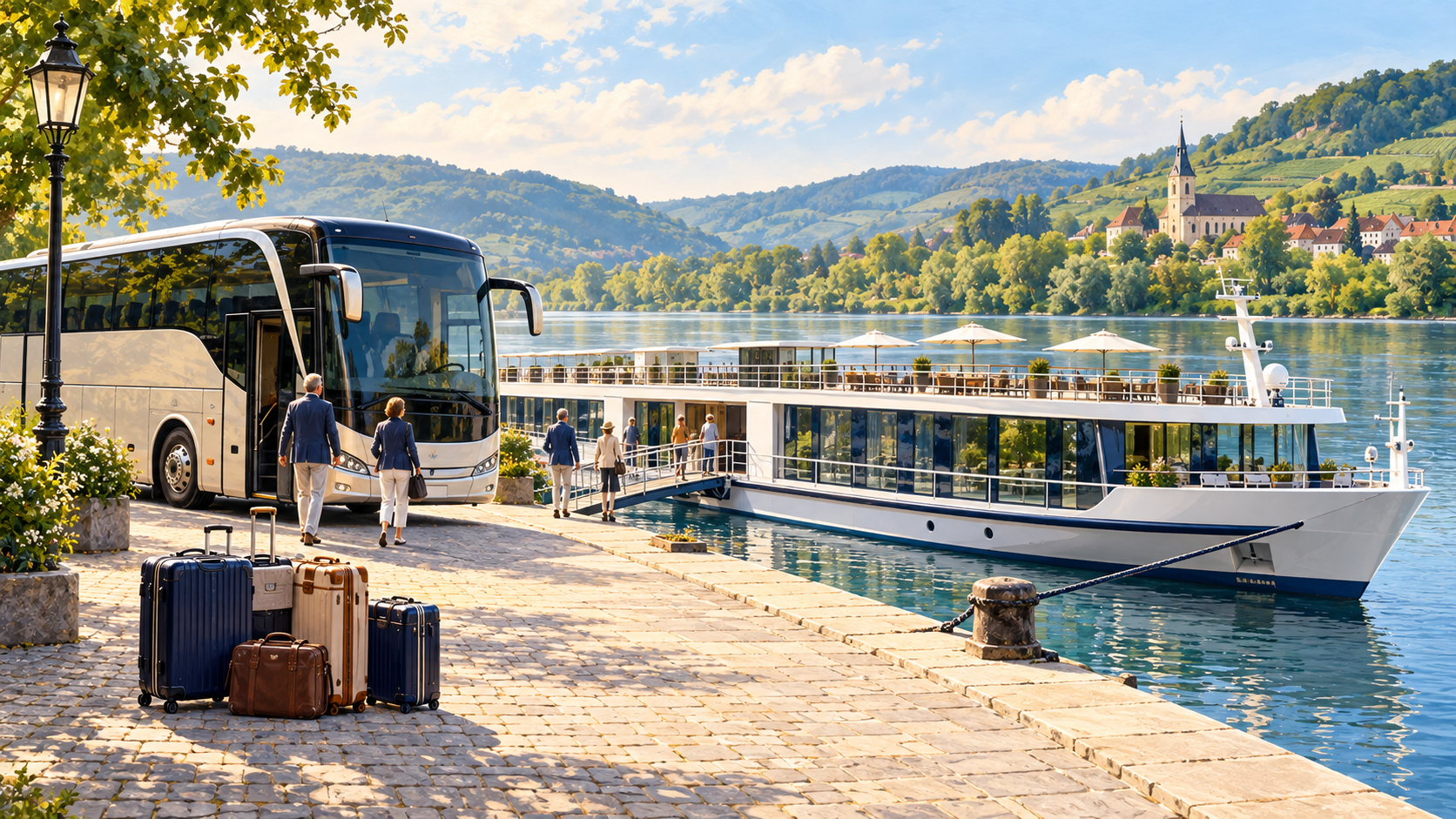
AI-generated transfer concept. Ship swaps depend on the operator, itinerary and available vessels.
Option 4: ship swap
Companies with multiple vessels positioned along the same river may sometimes use a ship swap.
Guests leave one vessel, travel around the impassable reach and board another vessel on the opposite side.
The advantage is that the river-cruise experience can continue.
The disadvantage is obvious: guests have to pack, transfer and unpack, and the seamless nature of the trip is interrupted.
Not every cruise line, itinerary or situation makes a ship swap possible.
Option 5: major itinerary revision
If several reaches are affected—or if the operational problem cannot be solved with a simple transfer—the cruise line may redesign the itinerary.
Ports can change. Overnight locations can change. Excursions can be substituted.
This is where travelers should read the cruise contract and the operator’s current travel advisories carefully.
Option 6: cancellation
Cancellation is possible, but it is not the only response to low water.
River-cruise operators generally try to preserve the trip when it can be operated safely and reasonably.
Whether a specific sailing is cancelled depends on conditions, available ships, logistics and the cruise line’s judgment.
Why companies can make different decisions
Two ships can encounter the same river and produce different outcomes because of:
Vessel draft
Vessel dimensions
Exact location and timing
Availability of sister ships
Dock availability
Local navigation restrictions
Company logistics
Excursion and transportation resources
This is why social-media reports from another ship should be treated as useful evidence—not a guaranteed prediction of what your ship will do.
When should a traveler start paying close attention?
Months before departure, today’s river level is mostly context.
As departure approaches, the information becomes progressively more useful.
The 30-, 14- and 7-day checkpoints below are an advisor’s planning checklist, not official forecast horizons or cruise-line notification deadlines. Follow your operator’s instructions whenever they arrive.
About 30 days out
Look for the trend.
Has the basin been persistently dry? Are several gauges below low-water references? Are navigation authorities reporting repeated bottlenecks?
About 14 days out
Start looking at actual operations.
Are river ships passing through the relevant reaches? Are cruise lines changing embarkation points or using buses?
About 7 days out
Weather forecasts, gauge forecasts, current fairway soundings and cruise-line communications become much more relevant.
Check the horizon of each forecast: viadonau’s shallow-section depth forecasts extend 24, 48 and 72 hours, not a full week.
Even then, rivers can change quickly.
Ask the right question
Instead of asking:
“Is the Danube low?”
Ask:
“Which sections of my itinerary are currently navigation-sensitive, what do the relevant gauges and fairway soundings show, and what are ships actually doing there?”
That question is much harder to answer—but much more useful.
A note on 2026
In its September 9, 2026 public update, Viking reported abnormally low water on sections of the Danube and said select itineraries could be modified.
That deserves attention.
It does not mean every future Danube cruise will be disrupted.
The river is dynamic, and conditions can change considerably between the day you read a headline and the day your ship sails.
The purpose of this series
My goal with this Danube series is not to convince travelers that river cruising is risk-free.
It isn’t.
The goal is to replace alarming numbers with context.
We now have a framework:
Understand what gauges actually measure.
Know the history of low water.
Understand why some sections are controlled and others are not.
Identify the corridor your cruise uses.
Watch the gauges and fairway depths that actually matter.
Look at what ships are doing—not just what headlines are saying.
That is how we turn “The Danube is at 50 centimeters” into information a traveler can actually use.
Continue the Danube Water Levels Series
Danube Water Levels Explained: Gauges, Depth & River Cruises
Why Isn’t the Entire Danube Controlled? Dams, the Green Movement and a Changing River
Classic Danube Water Levels: Wachau, Vienna, Bratislava and Budapest
Middle & Lower Danube Water Levels: Budapest to Romania and the Black Sea
Sources & Further Reading
This article is part of Conversations from the Planning Desk™ and is intended to help travelers understand river conditions—not to predict the operation of a specific sailing. River levels, fairway depths and cruise operations can change quickly.
viadonau — Draught, gauge height, fairway depth and keel clearance
viadonau — Shallow sections and short-range fairway forecasts
AmaWaterways — Passenger Ticket Contract (EU example; consult the contract for your own booking)
Danube FIS Portal — Navigation bottlenecks and fairway information
In This Series
Danube Water Levels Series · Article 7 of 7
Previous Article: Middle & Lower Danube Water Levels: Budapest to Romania and the Black Sea | Series: Danube Water Levels
Danube Water Levels Explained: Gauges, Depth & River Cruises
Why Isn’t the Entire Danube Controlled? Dams, the Green Movement and a Changing River
Classic Danube Water Levels: Wachau, Vienna, Bratislava and Budapest
Middle & Lower Danube Water Levels: Budapest to Romania and the Black Sea
What Happens When a Danube River Cruise Ship Can't Get Through? — Current article
Planning a Danube River Cruise?
River conditions are only one part of choosing the right itinerary, ship and time of year. If you're considering a Danube cruise, I can help you compare the options and understand how the different routes may fit your travel plans.
Schedule a consultation and let's talk through your trip.