Why Isn't the Entire Danube Controlled? Dams, the Green Movement and a Changing River
Why Isn’t the Entire Danube Controlled?
DANUBE WATER LEVELS SERIES · ARTICLE 3 OF 7
If low water can disrupt navigation, there is an obvious question:
Why don’t they just build more dams and control the Danube?
Europe has been asking versions of that question for generations.
The answer involves engineering, electricity, flood protection, navigation, wetlands, fish, politics—and one of Eastern Europe’s most influential environmental movements.
Following the Danube Water Levels Series?
In Article 2, we looked at the Danube’s history of low water and why drought is not a new problem. This article picks up the story by looking at something humans can control: how much of the river we engineer.
Previous in the series — Article 2 of 7: Is Low Water on the Danube Something New? →
Humans have engineered the Danube for centuries
The Danube is not an untouched natural river.
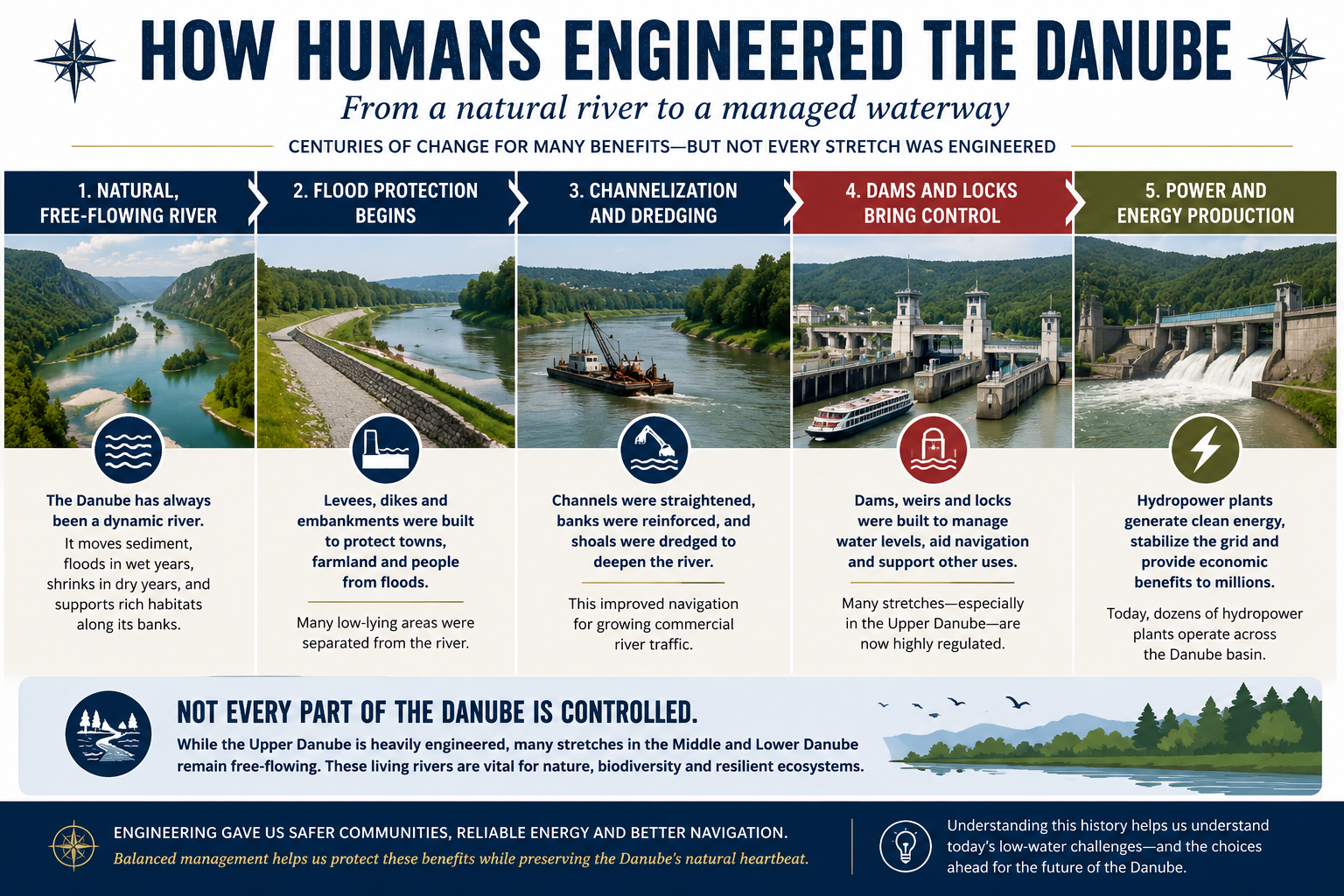
According to the ICPDR, people have altered rivers in the basin since at least the sixteenth century for flood defense, navigation and, later, hydropower.
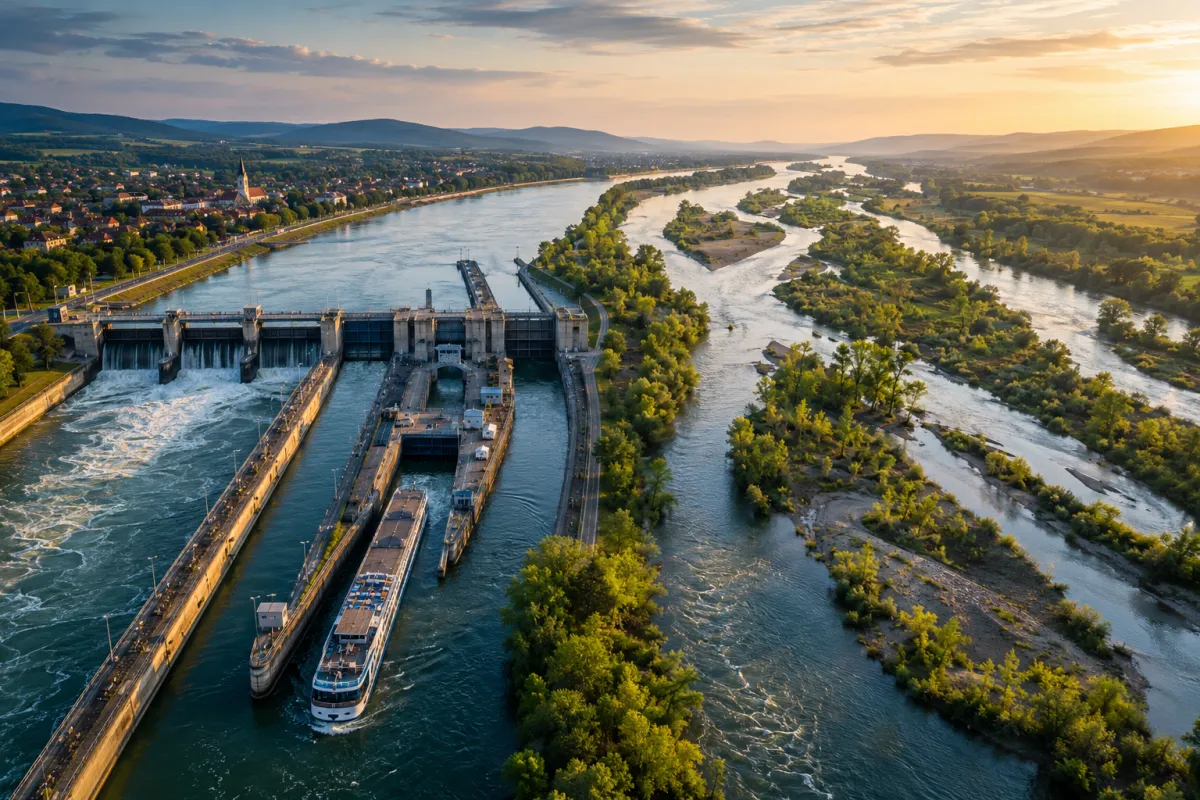
The Upper Danube became particularly engineered. Dams and weirs regulate many reaches, and the ICPDR notes that very few stretches of the Upper Danube can still be characterized as free-flowing.
For navigation, regulation can provide real benefits. Locks allow ships to overcome changes in elevation, reservoirs can stabilize certain water levels, and engineered channels can create more predictable fairways.
But dams change much more than navigation.
What a dam changes
A dam can make a section of river more predictable—but solving one problem can create others.
Water levels — A reservoir can hold and release water, helping regulate conditions within that particular stretch of river.
Navigation — Locks allow ships to move past dams and changes in elevation, creating a more dependable navigation channel.
Flood protection — Controlled water flows can help reduce flood risk in some areas, although dams cannot eliminate flooding.
Electricity — Hydropower uses the river to generate renewable electricity.
Nature — Dams interrupt the natural movement of water, sediment and fish and can permanently change wetlands and river habitats.
The dam project that helped launch a Green movement
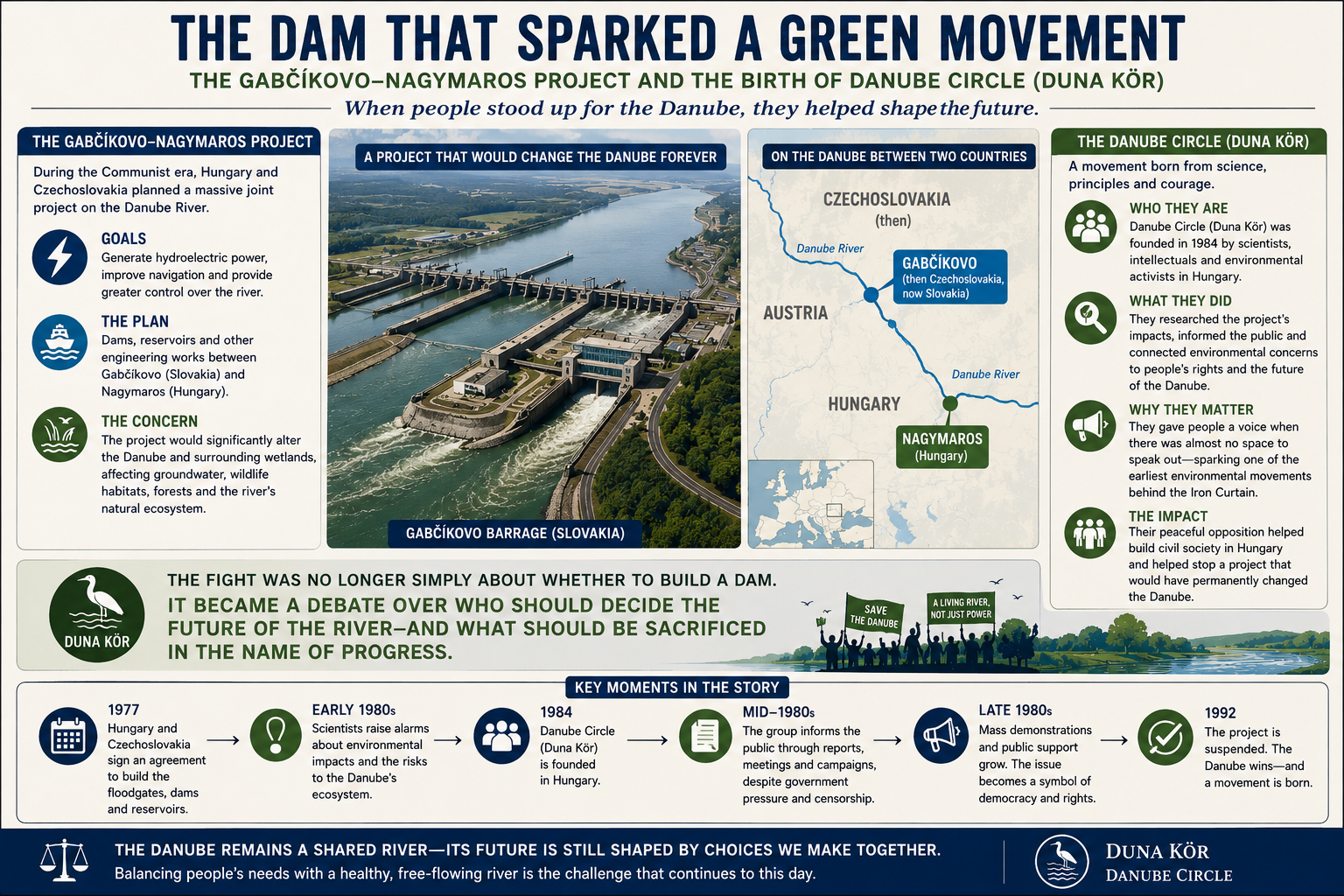
During the Communist era, Hungary and Czechoslovakia planned the Gabčíkovo–Nagymaros barrage system, a massive joint project on the Danube between the two countries.
The plan involved dams, reservoirs and other engineering works designed to generate hydroelectric power, improve navigation and provide greater control over the river.
But there was a tradeoff.
The project would significantly alter the Danube and surrounding wetlands. Scientists and environmentalists raised concerns about groundwater, wildlife habitats, forests and the river’s natural ecosystem.
Opposition grew in Hungary during the 1980s.
The Danube Circle, or Duna Kör, emerged in 1984 as scientists, intellectuals and environmental activists challenged the project and circulated information about its potential ecological consequences.
What began as opposition to a dam became something larger.
Because openly challenging government policy under Communist rule carried political significance, demonstrations against the project became part of the broader growth of Hungarian civil society during the final years of Communist rule.
The fight was no longer simply about whether to build a dam. It became a debate over who should decide the future of the river—and what should be sacrificed in the name of progress.
Why this matters today
The Danube Circle story matters because the debate did not end with one dam project.
It helped represent a broader change in how Europeans thought about managing rivers. Engineering the Danube was no longer automatically considered the best solution simply because it could improve navigation, generate electricity or provide greater control over water.
Environmental consequences became a much larger part of the decision.
That helps explain the Danube travelers encounter today. Some stretches are heavily regulated by dams and locks, while other important stretches remain much more natural and free-flowing.
And that has a direct connection to low water.
A free-flowing section cannot simply be maintained at a convenient depth the way a regulated reservoir can. When rainfall decreases, snowmelt changes or drought develops, water levels in those stretches can respond much more directly to natural conditions.
So when travelers ask, “Why don't they just control the river?”, part of the answer is that Europe made a deliberate choice not to engineer every remaining stretch of the Danube solely for navigation.
Protecting the river sometimes means accepting that the river will still behave like a river.
The Danube became a question of values
The debate was no longer simply:
Can we engineer the river?
It became:
How much should we engineer it—and what are we willing to lose in exchange for greater control?
That balance still shapes the Danube today. Navigation, hydropower and flood protection remain important, but so do wetlands, wildlife, groundwater and free-flowing stretches of river.
There is no single answer—and that is one reason different parts of the Danube behave so differently.
Europe’s modern restoration philosophy
Today, the goal is no longer simply to control as much of the Danube as possible.
In many places, European river policy tries to balance navigation, flood protection and hydropower with protecting or restoring the river’s natural environment.
That can mean restoring wetlands, reconnecting floodplains, improving fish passage and allowing some stretches of the river to remain free-flowing.
For travelers, the important point is simple:
Europe is not trying to turn the entire Danube into one controlled navigation channel.
Some sections are highly regulated. Others are deliberately allowed to behave much more naturally.
That difference helps explain why low water can affect one part of a Danube itinerary much more than another.
Does the Green movement cause today’s low water?
No.
Low water is caused by river and weather conditions—things such as rainfall, drought, snowmelt, temperature and evaporation.
The Green movement did not cause the Danube to have low water.
What environmental policy helped change is how Europe responds to low water.
Instead of automatically solving every navigation problem with another dam, deeper channel or additional river engineering, Europe now weighs those solutions against their effects on wetlands, wildlife, groundwater and the natural river.
So the Green movement didn't create the low water. It helped change what Europe is willing to do about it.
What this means on a river cruise
The result is a Danube that behaves differently from section to section.
Some reaches are highly controlled by dams and locks.
Others remain free-flowing and respond more directly to rainfall and drought.
That is why we cannot treat “the Danube” as one hydraulic system with one magic water-level number.
For travelers, the practical question becomes geographical:
Which kind of Danube does my itinerary sail?
That is where our next articles go.
Planning a Danube River Cruise?
River conditions are only one part of choosing the right itinerary, ship and time of year. If you're considering a Danube cruise, I can help you compare the options and understand how the different routes may fit your travel plans.
Schedule a consultation and let's talk through your trip.
Next: Upper Danube: Germany to the Wachau—where the river’s locks, tributaries and free-flowing reaches begin to matter to cruise navigation.
Sources & Further Reading
This article is part of Conversations from the Planning Desk™ and is intended to help travelers understand river conditions—not to predict the operation of a specific sailing. River levels, fairway depths and cruise operations can change quickly.
Danube Commission — Main gauges and navigation information: https://www.danubecommission.org/dc/en/danube-navigation/
Danube FIS Portal — Current navigation bottlenecks and fairway soundings: https://www.danubeportal.com/en/bottleNeck
ICPDR — Danube River Basin, climate adaptation and hydromorphology: https://www.icpdr.org/